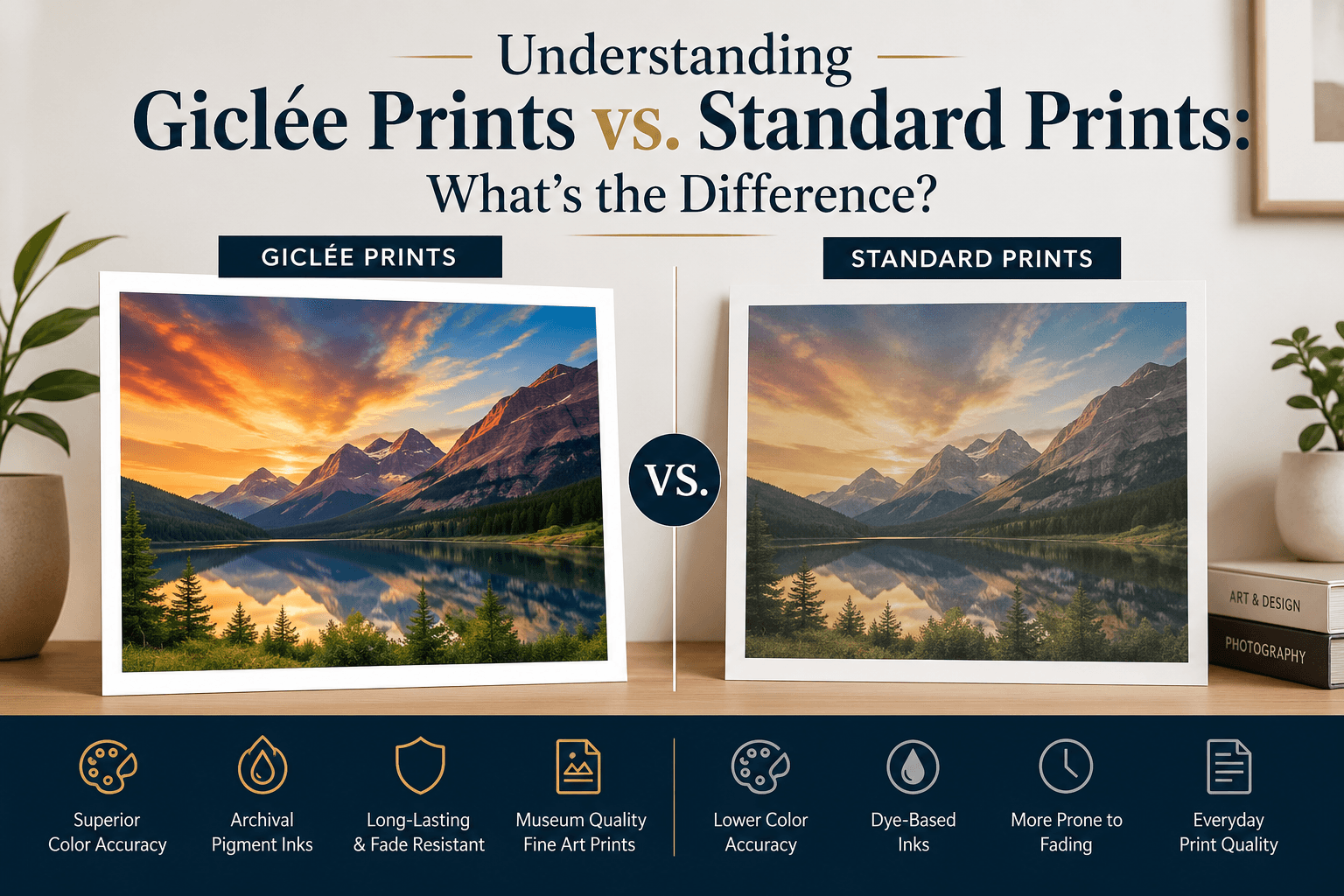
When shopping for artwork online, you’ve probably come across the term Giclée print. While both Giclée and standard prints may appear similar at first glance, the quality, longevity, and overall value can be dramatically different.
If you’re investing in fine art for your home, office, or collection, understanding these differences will help you make the right choice.
What Is a Giclée Print?
A Giclée (pronounced “zhee-clay”) print is a premium-quality inkjet print created using archival pigment inks and high-resolution printers. The word Giclée comes from the French word meaning “to spray,” referring to the precise ink-spraying technology used during printing.
Unlike ordinary prints, Giclée prints are designed to reproduce artwork with exceptional detail, vibrant colors, and museum-quality durability.
Key Features of Giclée Prints
Museum-quality color reproduction
Archival pigment-based inks
Printed on premium fine art paper or canvas
High-resolution printing (typically 300 DPI or higher)
Fade-resistant for 100+ years under proper conditions
Excellent texture and sharpness
Ideal for collectors, galleries, and artists
What Is a Standard Print?
A standard print is produced using conventional commercial printing methods or standard inkjet printers. These prints are perfect for everyday use but generally don’t offer the same level of detail, color accuracy, or lifespan as Giclée prints.
Standard prints are commonly used for:
Posters
Marketing materials
Decorative wall art
Promotional prints
Everyday photo printing
They’re an excellent budget-friendly option when museum-quality preservation isn’t required.
Giclée Prints vs. Standard Prints
| Feature | Giclée Prints | Standard Prints |
|---|
| Print Quality | Museum-quality | Standard commercial quality |
| Ink Type | Archival pigment inks | Dye-based or standard inks |
| Color Accuracy | Exceptional | Good |
| Resolution | Ultra-high resolution | Standard resolution |
| Longevity | 100+ years | 10–30 years (depending on conditions) |
| Fade Resistance | Excellent | Moderate |
| Paper Quality | Fine art paper or canvas | Regular paper |
| Best For | Collectors, artists, galleries | Posters, décor, general printing |
| Cost | Higher | More affordable |
Color Accuracy
One of the biggest advantages of Giclée printing is its incredible color accuracy.
Professional Giclée printers can reproduce millions of colors with smooth gradients and subtle tonal transitions, making them nearly identical to the original artwork.
Standard prints often lose subtle color details and may appear flatter or less vibrant.
Print Longevity
If longevity matters, Giclée prints are the clear winner.
Because they use archival pigment inks and acid-free materials, Giclée prints can last over a century when displayed and stored correctly.
Standard prints, especially those using dye-based inks, tend to fade much faster when exposed to sunlight or humidity.
Paper Quality Makes a Difference
Giclée prints are typically produced on:
These materials enhance the artwork’s appearance and provide exceptional durability.
Standard prints usually use thinner commercial paper that lacks the texture and archival qualities of fine art media.
When Should You Choose a Giclée Print?
Choose a Giclée print if you want:
Artists also prefer Giclée printing because it allows them to sell limited-edition reproductions that closely match the original painting.
When Is a Standard Print Enough?
A standard print is ideal if you need:
Affordable wall décor
Event posters
Temporary displays
Marketing materials
Everyday photo prints
Budget-friendly artwork
If longevity and collector value aren’t priorities, standard printing offers excellent value.
Are Giclée Prints Worth the Extra Cost?
For art lovers, collectors, and professional decorators, the answer is yes.
Although Giclée prints cost more upfront, they provide:
If you’re purchasing artwork you plan to enjoy for many years, a Giclée print is a worthwhile investment.
Final Thoughts
Both Giclée and standard prints have their place, but they serve different purposes.
If you’re looking for museum-quality artwork with exceptional detail, archival durability, and vibrant colors that stand the test of time, Giclée prints are the superior choice.
On the other hand, if you’re decorating on a budget or need prints for short-term use, standard prints offer an affordable and practical solution.
Understanding the difference helps you choose the right print based on your budget, expectations, and how long you want your artwork to last.
Frequently Asked Questions (FAQs)
Is a Giclée print better than a standard print?
Yes. Giclée prints offer higher color accuracy, better materials, archival inks, and significantly longer lifespan.
How long do Giclée prints last?
With proper care, Giclée prints can last over 100 years without noticeable fading.
Why are Giclée prints more expensive?
They use premium archival pigment inks, fine art paper or canvas, advanced printers, and higher production standards.
Can photographers use Giclée printing?
Absolutely. Many professional photographers choose Giclée printing for exhibitions and limited-edition prints because of its superior image quality.
Are Giclée prints worth buying?
If you value long-lasting quality, museum-grade color accuracy, and collectible artwork, Giclée prints are an excellent investment.