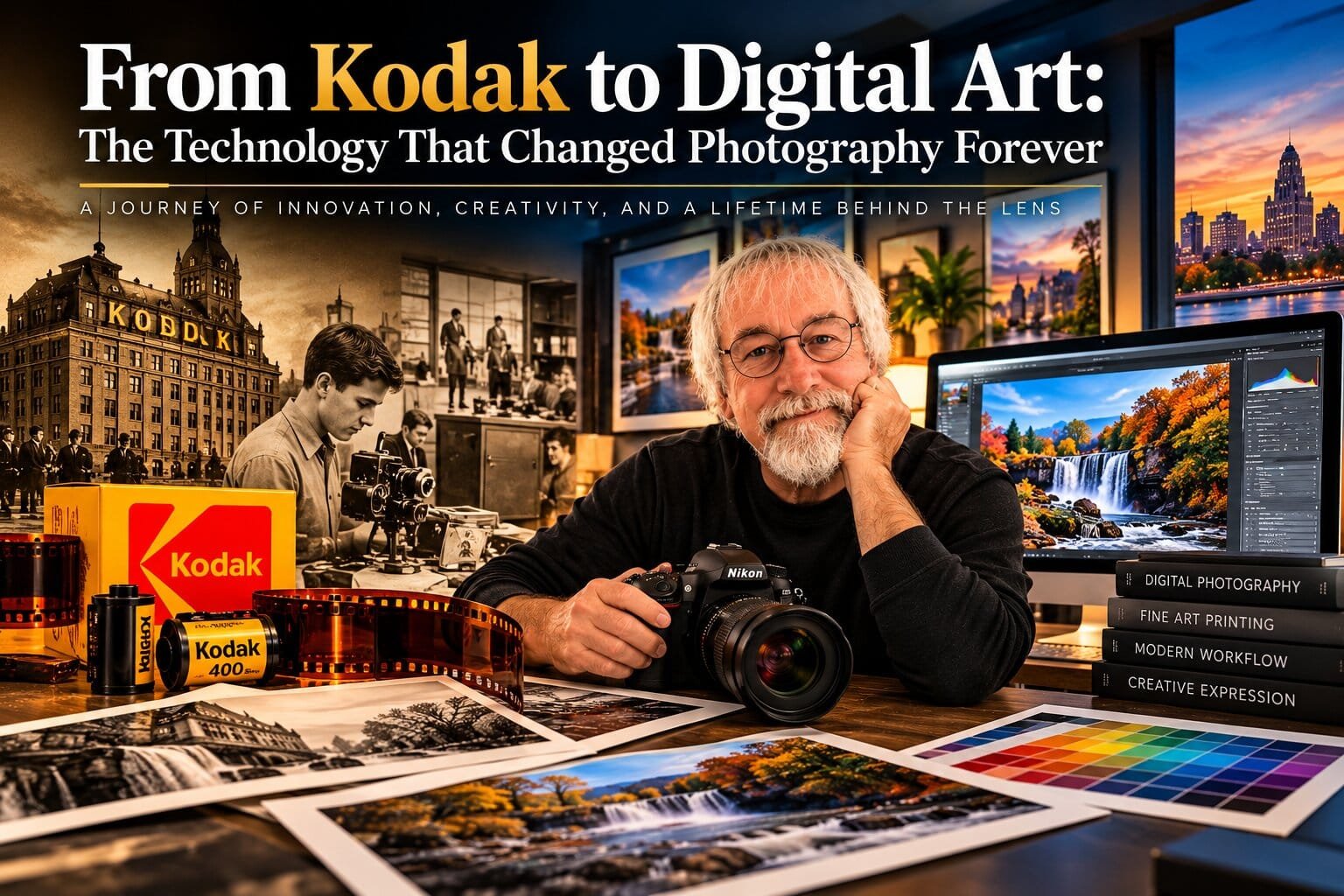
From Kodak to Digital Art: The Technology That Changed Photography Forever
How the transition from film to digital imaging transformed photography, opened new creative possibilities, and shaped the artistic journey of Peter J. Sucy.
For generations, photography depended on film, chemical processing, and carefully controlled darkroom techniques. Every photograph began with light passing through a lens and exposing a physical piece of film. To see the final result, photographers often had to wait until the film was developed.
Then a technological revolution began to change everything.
Computers, electronic image sensors, digital storage, and image-editing software gradually transformed photography from a primarily chemical process into a new form of digital expression. One company stood at the center of this transformation: Eastman Kodak.
For artist and photographer Peter J. Sucy, this was more than a technological change. It was a period he experienced firsthand while working within Kodak’s emerging electronic photography operations. His journey from traditional photography to digital imaging offers a unique perspective on how technology can reshape the creative process.
The World of Photography Before Digital Technology
Before digital cameras became practical, photographers relied on film to capture images. The quality of a photograph depended on many factors, including the film stock, exposure, lighting, lens quality, and development process.
Film photography required patience and technical knowledge. Photographers had to understand how light interacted with film and how chemical processing affected the final image.
For Peter J. Sucy, photography was an important part of his early artistic life. He worked with traditional photographic equipment and used 35mm film, including Kodachrome slide film, to capture landscapes and the natural world.
However, the arrival of personal computers presented an entirely new opportunity. Instead of limiting image creation to cameras, film, and darkrooms, computers offered a way to manipulate images, experiment with visual ideas, and produce artwork through a digital workflow.
The question was no longer simply how to capture a photograph. It was how technology could expand what an artist could create.
Kodak and the Beginning of Digital Photography
Kodak played a significant role in the development of digital imaging. In 1975, Kodak engineer Steven Sasson built an experimental digital camera that captured black-and-white images using an electronic image sensor and stored the resulting data on a cassette.
The prototype was a long way from the digital cameras we use today, but it demonstrated an important principle: an image could be captured electronically rather than recorded on photographic film.
During the following decade, advances in image sensors, computer hardware, storage technology, and color imaging helped make digital photography increasingly practical.
Kodak continued developing technologies that could support new forms of electronic photography. In 1986, the company announced a 1.4-megapixel image sensor, an important milestone in the development of higher-resolution digital imaging.
Yet the future was far from certain. Digital sensors were expensive, computers had limited memory and processing power, and many electronic imaging systems relied on analog video technology rather than fully digital image storage.
The challenge was not simply inventing a digital camera. It was building an entire system capable of capturing, processing, storing, displaying, and printing digital images at an acceptable quality and cost.
Peter J. Sucy’s Experience Inside Kodak
Peter J. Sucy’s story is particularly interesting because he experienced the transition from the perspective of both an artist and a technology professional.
After purchasing an Apple Macintosh in 1984, Peter began exploring the computer as a creative tool. Its graphical interface and drawing capabilities offered an alternative to traditional methods of creating visual artwork.
His interest in computers coincided with a period of significant change at Kodak. In 1986, Kodak formed its Electronic Photography Division, where Peter became involved in the development and communication of emerging imaging technologies.
As someone who understood photography and wanted better digital tools, Peter recognized that computers could become much more than devices for spreadsheets, word processing, or technical calculations.
They could become part of the artistic process itself.
Peter began scanning photographs, editing images on his Macintosh, and showing printed examples to colleagues. He wanted others to see the possibilities of digital imaging and understand why the future of photography would depend on more than traditional film or analog video.
His perspective was shaped by a practical question: if a digital image could be captured, edited, stored, and reproduced without the same generational degradation associated with analog recording, why should the industry delay adopting digital technology?
This was a period of experimentation, uncertainty, and competing ideas about the future.
Peter’s firsthand account of these developments is explored in his digital history series, Silver to Silicon: A Retrospective.
The Macintosh and the Rise of Computer-Based Creativity
The personal computer became one of the most important tools in the evolution of digital photography.
In the early 1980s, computer graphics were limited by modest processing power, restricted memory, and relatively basic display capabilities. Even so, the Macintosh helped make computer-based creative work more accessible through its graphical interface and mouse-driven interaction.
For artists, this created an entirely new way to work with images.
A photograph could be scanned into a computer, modified on screen, combined with other visual elements, and printed without repeating the traditional photographic process for every change.
The ability to undo a mistake was especially significant. Instead of starting over after an unsuccessful drawing or alteration, artists could experiment, reverse decisions, and explore different approaches.
For Peter, these capabilities were personally meaningful. Difficulties with hand pain had made some traditional drawing activities challenging, and computer-based creation provided another way to continue working creatively.
Technology did not remove the need for artistic judgment. Instead, it offered a different path for expressing ideas.
From Electronic Images to Digital Image Editing
The transition from film to digital photography involved much more than the development of new cameras.
It required an ecosystem of tools that could work together.
Image sensors converted incoming light into electronic signals. Computers processed image data. Software made it possible to manipulate images, while printers and other output devices brought digital creations into the physical world.
The release of Adobe Photoshop 1.0 in 1990 marked an important development in this broader transformation. Image-editing software gave photographers and artists new ways to adjust and manipulate digital images.
Color, contrast, composition, and visual effects could be explored with increasing flexibility. Images could also be combined to create compositions that extended beyond the boundaries of conventional photography.
Peter explored these possibilities through his work with digital imaging tools and 3D graphics. His early digital artwork demonstrated how computer-based image creation could become an artistic medium in its own right.
One example is a 1992 composite image combining Photoshop and StrataVision 3D, illustrating the emerging relationship between image editing and computer-generated imagery.
For artists, this was the beginning of a much broader creative landscape.
Why Digital Images Changed the Way Artists Work
Digital imaging changed photography in several fundamental ways.
1. Greater freedom to experiment
Digital editing allows artists to test different colors, compositions, and visual effects without having to recreate the entire image from the beginning.
2. Easier image storage and reproduction
Digital files can be copied, backed up, and transferred without the generational image degradation associated with repeatedly copying analog recordings. The quality of a particular file still depends on its resolution, compression, and processing.
3. New forms of visual expression
Photography can now be combined with illustration, 3D modeling, digital compositing, animation, and other creative disciplines.
4. A different relationship between artist and technology
Computers are no longer merely tools for managing photographs. They can become active parts of the creative workflow, helping artists develop ideas that would be difficult to achieve through traditional methods alone.
These developments did not make film photography obsolete as an artistic practice. Film continues to offer distinctive visual qualities and remains valuable to many photographers.
Instead, digital technology expanded the choices available to artists.
Beyond Photography: Exploring 3D Digital Art
As digital imaging developed, Peter’s artistic interests extended beyond conventional photography.
Computer-generated imagery made it possible to create virtual objects, manipulate perspective, build complex compositions, and explore the illusion of depth.
Peter later worked with 3D modeling, rendering, and lenticular imaging. In 2001, he co-founded Zaxys Depth & Motion Imaging, a company focused on 3D lenticular design.
Lenticular imaging uses specially designed lenses and carefully prepared images to create effects such as apparent depth or changes in an image when viewed from different angles.
These techniques demonstrate how the foundations of digital photography can lead to entirely different artistic experiences.
Today, Peter’s work spans photography, digital art, 3D imagery, and sculptural experimentation. His career illustrates how a photographer can build upon traditional visual skills while continuing to explore new technologies.
You can explore his creative work through the Peter J. Sucy Digital Arts website.
What the Digital Revolution Teaches Us About Art
Looking back at Kodak’s early digital era reveals an important lesson: technological progress does not always happen as quickly as the technology itself develops.
New ideas must compete with established practices, existing investments, and uncertainty about what customers will want.
The transition from film to digital photography required more than technical breakthroughs. It required people willing to question familiar methods and imagine different possibilities.
Peter J. Sucy’s experience highlights the value of approaching technology with both technical understanding and artistic curiosity.
His journey also demonstrates that innovation is not limited to inventing a new device. It can involve recognizing how existing technologies might be combined to create something entirely new.
Photography has continued to evolve through digital cameras, advanced editing software, mobile devices, 3D imaging, and artificial intelligence. Each development introduces new creative opportunities while raising fresh questions about originality, technique, and artistic expression.
Yet one principle remains constant: technology is most meaningful when it helps people communicate ideas and see the world differently.
Conclusion: From Silver to Silicon
The journey from film photography to digital art represents one of the most important transformations in modern visual culture.
Kodak’s role in early digital imaging, the development of personal computers, and the arrival of sophisticated editing tools helped establish the foundations of the digital creative world we know today.
For Peter J. Sucy, this transformation was not simply something to observe in retrospect. It was part of his professional and artistic journey.
From traditional photography and early Macintosh experiments to digital imaging, 3D artwork, and contemporary creative technologies, his work reflects a continuing interest in what becomes possible when art and technology meet.
The tools will continue to change. The challenge for artists is to keep exploring, questioning, and creating.
Explore more of Peter J. Sucy’s work and his firsthand account of the digital imaging revolution at peterjsucy.com.
About the Artist
Peter J. Sucy is a digital artist, photographer, and 3D imaging creator whose career spans more than five decades. His work explores the intersection of photography, computer graphics, digital art, and emerging imaging technologies.
Discover his artistic journey through Silver to Silicon: A Retrospective and explore his digital imaging history.