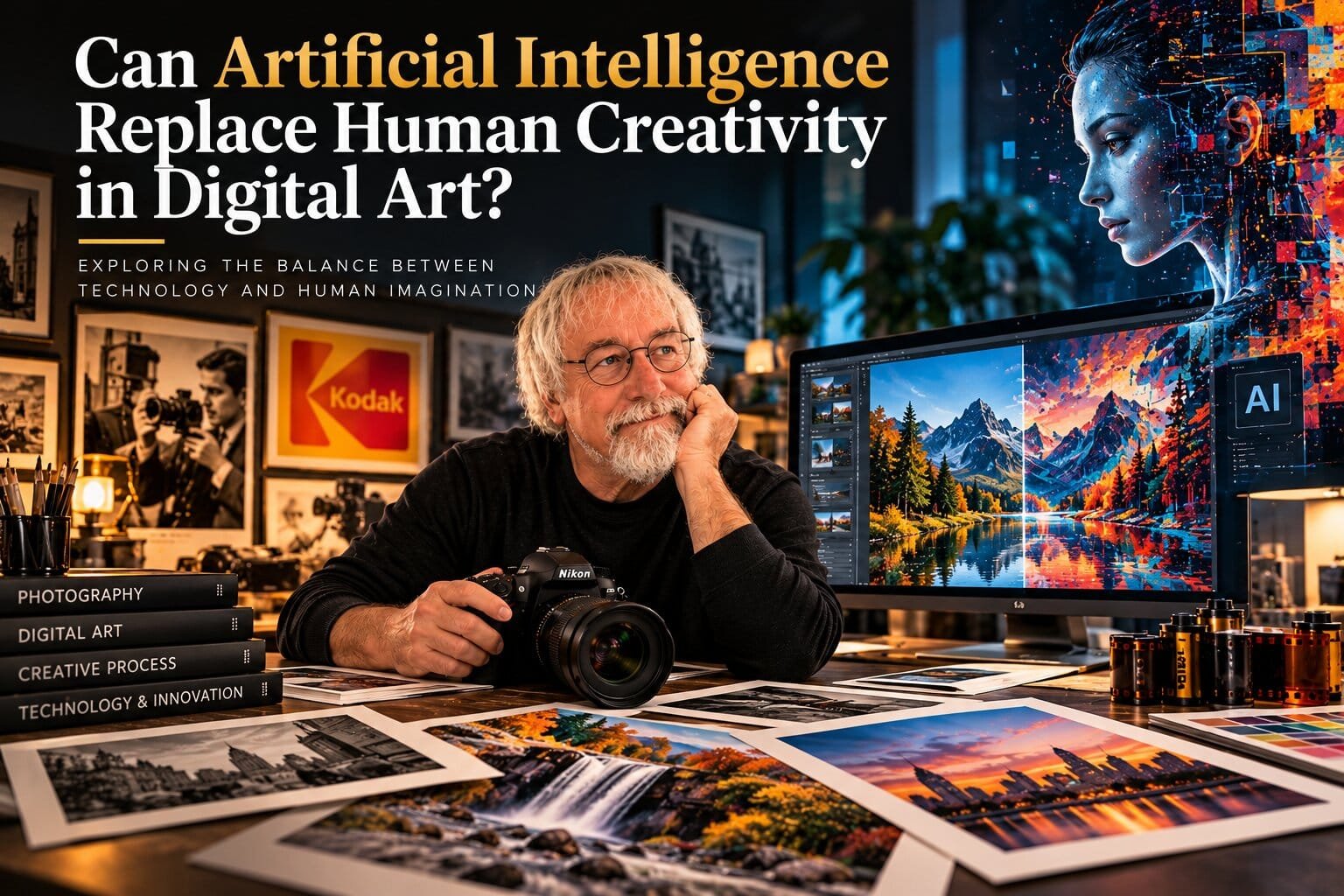
Can Artificial Intelligence Replace Human Creativity in Digital Art?
Exploring the relationship between artificial intelligence, human imagination, and the future of digital art.
Artificial intelligence is changing the way people create images. With a simple written prompt, AI-powered tools can generate realistic photographs, imaginative landscapes, abstract compositions, and intricate digital illustrations in seconds.
What once required hours of drawing, photography, modeling, or digital editing can now begin with a few lines of text.
This development raises an important question: Can artificial intelligence replace human creativity in digital art, or is it simply another tool artists can use to express their ideas?
For artists who have witnessed the evolution from traditional photography to computer-generated imagery, this question represents another chapter in a much longer story. Technology has repeatedly changed how art is produced, but the relationship between technical innovation and human imagination remains central to the creative process.
How Artificial Intelligence Is Changing Digital Art
Digital art has evolved significantly since artists first began experimenting with personal computers and early image-editing software.
In the beginning, creating digital artwork often required specialized knowledge of computer graphics, image manipulation, and rendering. Artists needed to understand their tools and develop techniques through experimentation.
Today, generative AI systems can produce images based on descriptions, reference images, and other inputs. Some tools can also modify existing artwork, expand an image, remove objects, generate textures, or help create variations of a composition.
These capabilities make digital art more accessible to people who may not have extensive technical experience.
AI can help artists:
- Explore different visual concepts quickly.
- Generate ideas for compositions, colors, and lighting.
- Create preliminary sketches and visual references.
- Experiment with imaginative scenes that would be difficult to photograph.
- Develop alternative versions of an existing concept.
- Speed up repetitive tasks in an established creative workflow.
However, generating an image and creating a meaningful work of art are not necessarily the same thing.
The technology can produce visual possibilities, but deciding which possibilities communicate something meaningful still requires judgment.
What Makes Human Creativity Different?
Human creativity is influenced by experience, memory, emotion, observation, culture, and personal interpretation.
An artist might create a photograph because a particular landscape reminds them of childhood. Another might use abstract shapes to explore uncertainty or combine digital imagery with personal experiences to tell a story.
These motivations are not simply technical instructions. They emerge from an individual’s relationship with the world.
Human artists also make decisions throughout the creative process. They determine what deserves attention, what should be removed, which imperfections should remain, and when an artwork feels complete.
Artificial intelligence can generate compelling visual results, but the meaning and purpose of a particular artwork depend on its context and how people interpret it.
This distinction is important. Creativity is not measured only by how quickly an image can be produced or how realistic it appears. It can also involve originality, intention, emotional resonance, experimentation, and the ability to communicate a distinctive point of view.
AI can participate in the creative process without making human artistic judgment irrelevant.
From Traditional Photography to AI-Generated Images
The history of photography offers a useful way to understand this transition.
When photography emerged, it introduced a new method of representing the world. Cameras could record details with a speed and precision that challenged traditional approaches to visual representation.
Over time, photography developed into much more than a way to document reality. Photographers used composition, lighting, perspective, exposure, and timing to express individual viewpoints.
Digital photography brought another major change. Images could be edited, combined, and transformed using computers. Some photographers embraced these possibilities, while others continued to value the distinctive qualities of film and traditional darkroom techniques.
The introduction of digital editing did not eliminate the need for artistic vision. Instead, it expanded the range of available techniques.
Artificial intelligence may represent a similar transition, although its ability to generate imagery from learned patterns introduces new questions about authorship, training data, and originality.
As with earlier technologies, the challenge is not simply deciding whether a new tool is good or bad. It is understanding what the tool makes possible, what limitations it introduces, and how artists can use it thoughtfully.
Can AI Understand Art, or Does It Generate Patterns?
Generative AI systems learn statistical patterns from training data and use those patterns to produce new outputs. Depending on the system, they can combine visual characteristics associated with different subjects, styles, and compositions.
The results can be impressive. AI-generated images may contain sophisticated lighting, complex textures, imaginative forms, and striking arrangements.
Yet visual sophistication does not automatically establish artistic intention.
An AI system can generate an image that appears melancholy, dramatic, or joyful. Whether the image communicates those qualities successfully is something viewers interpret through their own experiences and expectations.
Human artists also learn from existing images, artistic traditions, and the work of others. The difference is not that human creativity develops in isolation. Rather, human artistic practice is connected to lived experience, deliberate intention, physical interaction with materials, and social and cultural context.
AI-generated artwork challenges artists and audiences to think more carefully about what makes an image original, meaningful, and worth experiencing.
Why Artistic Judgment Still Matters
Imagine asking an AI system to generate a sunset over a lake.
It might produce a visually attractive image almost immediately. The colors could be dramatic, the reflections carefully arranged, and the composition balanced.
But suppose the goal is to create an artwork that communicates the feeling of standing beside a particular lake after losing someone important.
The technical requirements might include the right lighting, colors, and landscape. The deeper artistic goal involves deciding which visual details express the intended experience.
An artist could use AI to explore possible compositions, then photograph the real location, incorporate personal imagery, alter the colors, or combine multiple techniques to create a final work.
In this scenario, AI contributes to the process without defining the entire creative purpose.
The artist remains responsible for deciding what the work should communicate and whether the final result achieves that objective.
The value of an artist is not limited to the ability to produce an image. It also lies in deciding what is worth creating and why.
AI as Another Tool in the Digital Artist’s Toolkit
Artists do not need to choose between traditional methods and artificial intelligence. Many creative workflows can combine several approaches.
A photographer might use AI to remove an unwanted object while preserving the original photograph’s composition. A digital artist might generate reference images before creating a more detailed illustration. A 3D artist could use AI-generated concepts to explore possible environments before modeling and rendering the final scene.
Other artists may choose not to use AI at all, preferring the control and process associated with drawing, photography, sculpting, or conventional digital editing.
These choices can reflect different artistic priorities.
The most useful approach depends on the intended result, the artist’s values, the project’s requirements, and the level of control needed over the finished work.
AI is particularly useful for rapid experimentation, but artists must still evaluate its output. Generated images can contain visual inconsistencies, distorted details, inaccurate representations, or elements that do not serve the composition.
Human oversight remains important when quality, accuracy, and artistic consistency matter.
The Challenges of AI-Generated Art
Although AI offers exciting possibilities, its growing use raises several important concerns.
1. Originality and artistic identity
When many people use similar prompts and tools, their results may share recognizable visual characteristics. Artists must consider how to develop a distinctive perspective rather than relying entirely on default outputs.
2. Copyright and training data
Questions remain about the use of copyrighted images in AI training, the rights of artists whose work may be included in training datasets, and the legal status of AI-generated content. Laws and court decisions vary by jurisdiction and continue to evolve.
Artists should understand the terms of the tools they use and avoid assuming that every generated image is automatically free of copyright or licensing concerns.
3. Authenticity and disclosure
Audiences may want to know whether an artwork was photographed, drawn, digitally manipulated, or generated primarily through AI. Being transparent about the creative process can help artists build trust with clients, galleries, and collectors.
4. The value of artistic skill
If a tool can generate an image quickly, artists may feel pressure to compete on speed or price. Yet visual art also involves concept development, technical refinement, storytelling, consistency, and the ability to respond to a client’s needs.
These skills can remain valuable even as image-generation technology improves.
5. Ethical representation
AI-generated imagery can reproduce stereotypes, create misleading depictions of real events, or imitate recognizable artistic styles. Artists should consider the consequences of their choices and the expectations of their audiences.
These concerns do not mean AI has no place in art. They highlight the importance of using the technology responsibly.
What the Future Holds for Digital Artists
Artificial intelligence will likely become an increasingly familiar part of photography, graphic design, illustration, and 3D imaging.
Future creative tools may provide more precise control over lighting, perspective, materials, motion, and image composition. They may also become more closely integrated with existing editing and modeling software.
For digital artists, this creates opportunities to spend less time on certain repetitive tasks and more time developing concepts, refining details, and exploring new forms of expression.
However, adapting to new technology does not mean abandoning established artistic skills.
Understanding composition, color theory, light, perspective, visual storytelling, and image quality can help artists evaluate AI-generated results and make more informed creative decisions.
Artists who combine technical knowledge with curiosity and a distinctive point of view may be better positioned to use these tools effectively.
The goal should not be to adopt every new technology simply because it exists. It should be to understand which tools genuinely support the work an artist wants to create.
What the Evolution of Digital Art Can Teach Us
The debate about AI and creativity reflects a recurring theme in the history of art: new technologies change the methods of creation, but they also challenge established assumptions about artistic skill and originality.
Photography changed the relationship between art and mechanical image-making. Digital cameras changed the way photographs were captured and stored. Image-editing software expanded the possibilities for transforming visual material. Computer graphics introduced new worlds that could be constructed entirely within a digital environment.
Artificial intelligence adds another dimension to this evolution by generating images from learned patterns rather than requiring artists to construct every visual element manually.
For artists whose careers span several technological generations, these developments offer an opportunity to reflect on what changes and what remains constant.
Peter J. Sucy’s work across photography, digital imaging, and 3D art provides a context for considering how creative practice can evolve alongside technology.
His artistic journey illustrates the value of experimentation and the willingness to explore new ways of working while maintaining an interest in the visual ideas behind the finished image.
You can explore his work and artistic history at Peter J. Sucy Digital Arts.
Conclusion: Can Artificial Intelligence Replace Human Creativity?
Artificial intelligence can generate images, suggest compositions, and help artists explore visual possibilities at remarkable speed. It is already changing how many people approach digital art.
But replacing the production of an image is not the same as replacing the full creative process.
Art involves decisions about meaning, intention, experience, context, and expression. These dimensions influence why an artwork is created, how it develops, and what it communicates to an audience.
AI can contribute to these processes, but artists must still decide how to use it, evaluate its results, and determine whether the finished work reflects their goals.
Some artists will embrace AI as a central part of their workflow. Others will use it selectively, and some will continue working entirely through traditional or established digital techniques.
There is room for different approaches.
Ultimately, the future of digital art may depend less on whether AI can replace artists and more on how artists choose to work with, respond to, or deliberately work without it.
Technology can expand the possibilities of art, but the choices we make about what to create remain at the heart of the creative experience.
About Peter J. Sucy Digital Arts
Peter J. Sucy explores the intersection of photography, digital art, computer-generated imagery, and 3D imaging. His work reflects a long-standing interest in the ways new technologies can expand visual expression.
Explore his artwork and creative journey at Peter J. Sucy Digital Arts.