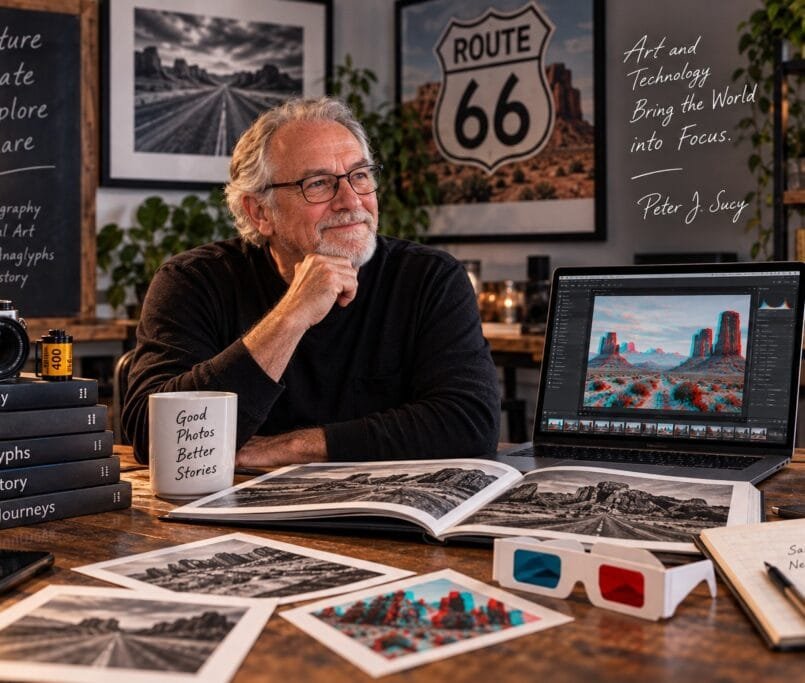
Where Art, Technology & Curiosity Meet
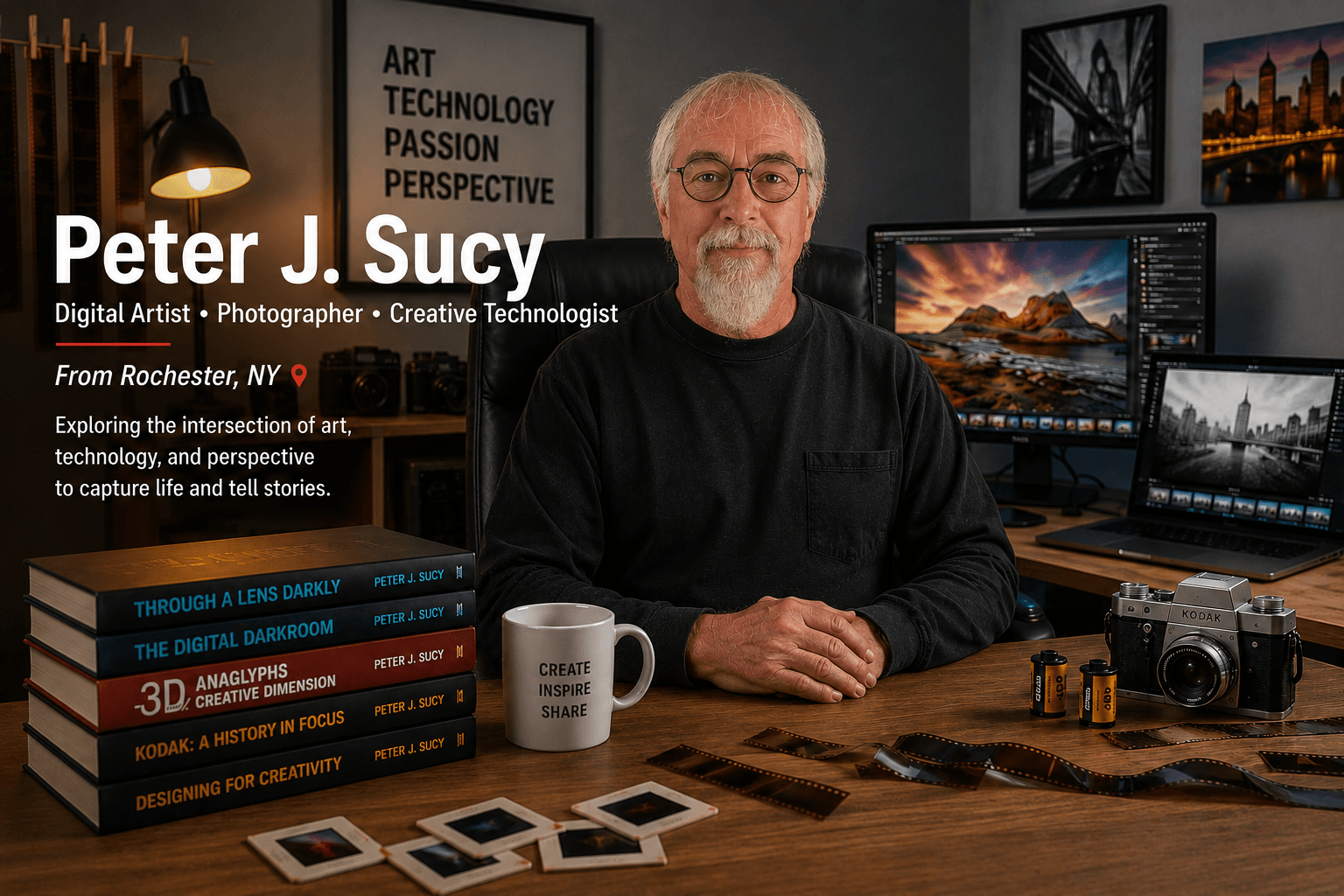
Peter J. Sucy’s creative story is closely tied to the changing way we make and experience images. Based in Rochester, New York, he has explored photography, digital art, 3D imaging and the tools that sit behind the creative process. His work is interesting because it does not treat technology as a replacement for creativity. Instead, each new tool becomes another way to experiment, learn and communicate an idea.
That attitude gives the portfolio a personal feel. There is room for finished images, technical history, creative experiments and the practical details of a working environment. Together they tell a bigger story: a photographer and artist continuing to look for better ways to see.
Roots in Rochester, Inspired by Kodak
Rochester has a special place in the history of photography. The city became strongly associated with Kodak and the development of photographic technology, creating an environment where cameras, film, imaging and innovation were part of the local culture. For an artist interested in the evolution of photography, that background provides a natural starting point.
Sucy’s connection with the region makes the transition from traditional photography to digital imaging more than a technical story. It becomes a story about how creative people adapt when an entire industry changes around them.
From Film to the Digital Darkroom
There is something special about film photography: the physical negative, the discipline of making an exposure, and the anticipation of seeing the final image. Digital photography changed that rhythm. Images could be reviewed immediately, edited on a computer and shared around the world without waiting for a traditional development process.
Rather than seeing those periods as opposites, Sucy’s work suggests a useful bridge between them. The lessons of the film era—composition, patience, light and visual storytelling—still matter when the camera becomes digital. The tools may change, but the eye behind the camera remains important.
Witnessing the Digital Imaging Revolution
One of the most significant themes connected to Peter J. Sucy is the transition from film to digital imaging. His book “Witness to a Revolution” documents that period from the perspective of someone who experienced the change around Kodak and digital imaging.
That perspective gives the subject a human side. Technological revolutions are often described through products and specifications, but the real story is also about people learning new workflows, questioning familiar habits and discovering possibilities that were not available before.
Digital Art: When a Photograph Becomes a Starting Point
Photography does not have to end when the shutter is pressed. Digital tools allow an image to become a starting point for illustration, manipulation, composition and visual experimentation. Sucy’s digital-art work reflects that wider creative space, where photography and computer-based design can overlap.
This approach is especially relevant today, when photographers regularly move between cameras, editing software, graphics tablets and other digital tools. The creative process is no longer limited to capturing a scene; it can continue through every stage of shaping the final image.
Seeing in Another Dimension: 3D & Anaglyph Work
Another distinctive area is 3D imaging and anaglyph art. Anaglyph images use separate visual information for the left and right eyes to create a sense of depth when viewed with appropriate glasses. The technique turns a familiar flat image into something that asks the viewer to engage differently.
For an artist, 3D introduces another creative decision: depth. Foreground, middle distance and background are no longer only compositional layers; they become part of the experience. That makes 3D work a natural extension of a lifelong interest in how images can change the way people see.
The Creative Workspace Matters Too
The tools used to create an image are only part of the story. A good creative workspace can make it easier to experiment, organize projects and stay focused. Sucy’s interest in desk design and the idea of an “ultimate” creative setup shows this practical side of the creative life.
A thoughtfully arranged workspace can bring together old and new: film and digital files, cameras and computers, reference material and modern editing tools. In that sense, the desk becomes a small picture of the larger journey—respecting where imaging came from while making room for what comes next.
A Career Built Around Staying Curious
The strongest thread running through Peter J. Sucy’s work is curiosity. Photography led toward digital imaging. Digital imaging opened doors to digital art. Experimentation moved into 3D, design and new ways of presenting visual information. Each step adds another layer rather than erasing the previous one.
That is a useful lesson for anyone working creatively today. Technology will continue to change, but the ability to learn, experiment and remain interested in the process can last much longer than any particular camera, computer or software package.
Explore More
For more of Peter J. Sucy’s photography, digital art, 3D work, books and creative projects, visit www.peterjsucy.com.
Peter J. Sucy | Photography • Digital Art • 3D Imaging