
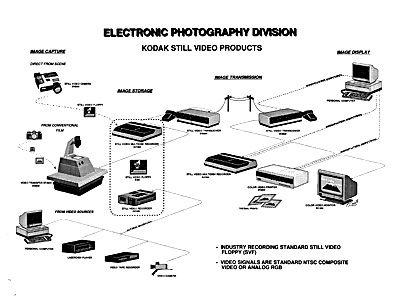
The State of EPD in 1987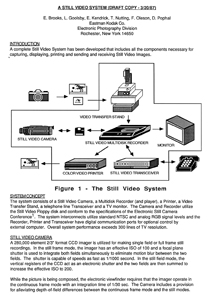 Click Image to View (requires PDF plugin) or Downlad a PDF of the Overview Above is the overview I helped prepare, with several of the lead engineers on the various projects, for an important management presentation. This represents the product plan in early 1987. None of the products were complete at this point, so there were no units to photograph. Except for the single disk player from Matsusita, which they had built for us. I believe the document was a combination of McPaint and MacDraw artwork laid out in Word. Further below is the same diagram, drawn after I received a beta copy of Illustrator 1.0. I was very dissappointed that nowhere in those product plans of 1987, was there any mention of computers or digital storage. Kodak was totally focused on the televsion video standard as a path forward. They had technology timelines for video technology standards but none had been done looking at computing standards. I began to express my concern that they were overlooking the many potential opportunities to use computers to control our devices, even store and edit images. Not to mention a large number of other photographic utilization scenarios. For several months the previous year I had been tasked with drawing up hundreds of scenarious for controling our video devices with computers. Mostly using the serial port on several of our devices. Unfortunately, at the time there were no plans to develop any drivers or software for any of the products. The serial ports were put there primarily for our internal software developers only. 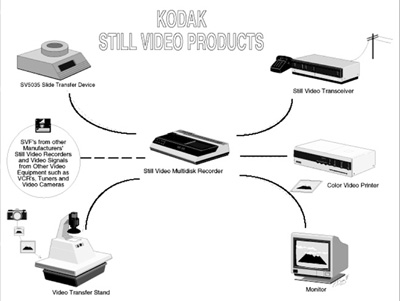 Together with John C., one of the lead software programmers of the SV7500 (and who shared my concerns), we set up a meeting with sales, marketing and product planning teams to sort of lay out the whole concept of connecting our devices to computers. We tried to explain to them what was needed. It was something that they had never even considered. There was quite a bit of resistance to the idea intitially. I think they were horrified when they heard our estimates to develop drivers, even more so when they discovered how much application development cost. And all we were asking for was a relatively small amount of funds just to develop the driver toolkits. That would at least allow 3rd party developers to develop software drivers that communicated with our devices. Marketing did not want to add any additional costs to the development of these first products. Probably because they had no idea how many they could sell. This total lack of understanding of these potential new markets, would lead to some costly decisions in the years to come. 
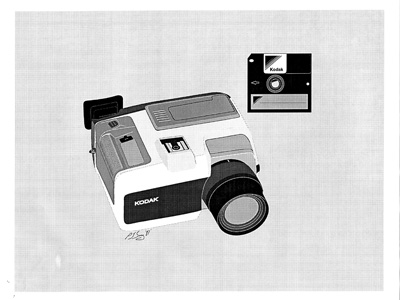
The Macintosh IINineteen eighty-seven (1987) marked a new era for Apple computer. The first color and easily expandable Mac, the Macintosh II, was announced at the January MacWorld event. This new MacII would feature a powerful new generation of Motorola processor, the 68020, an expandable bus architecture with six expansion slots and did I mention COLOR. The Macintosh was now open for development! The new architecture, based on the "NUBUS" standard, would allow the addition of specialized cards for expanded capabilities For example, true 24-bit monitor/display boards, image compression/manipulation, communications, and possibly much more. Now there was a color computer potentially capable of displaying 24 bit color images (without having to shell out nearly $8K for the AT&T Targa board, which was a solution with apps that only ran on the board, it did nothing for all your other PC programs). I say potentially, because the new Mac II was only available with a 13" monitor and a 640 x 480 pixel, 8 bit (or 256 color) display card. Apple apparently was leaving it up to 3rd party developers to provide more advanced viewing capabilities. Companies like Radius and SuperMac would step up to the challenge before the year was out. I would try to get Kodak to build a 24 bit display board for the Mac as well. Macintosh SE The Macintosh SE successor to the Mac Plust was also annouced along with the Macintosh II Macintosh Digital Imaging Peripherals Proposal #1Below is an actual copy of the proposal I drafted shortly after the Mac II announcement. (Sorry, I still don't know how to use the comma key, apparently.) Most within Kodak didn't realize how significant an announcement this would be. Few were following the developments in Silicon Valley. The few managers in the company that had computers, primarily used them for word processing, statistics or accounting. Most engineers still used slide rules. The few software engineers we had, for the most part, thought the Mac was just a toy. Not any longer. Realizing that the potential combination of the Mac II and desktop publishing was going to change the graphic/imaging landscape, I put together a quick proposal to try and convey the importance of the event. It did create some controversy, but did little to change people's minds. I had little cred at the time. Click on the Image to Read the Proposal 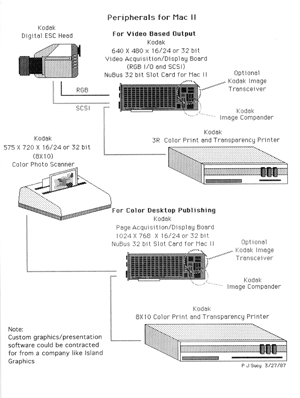 A Few Software Products that shipped in 1987ImageStudioThe first true image processing applications began to appear around this time. ImageStudio by Letraset was the first to offer true 8-bit grayscale editing for the Mac. The ThunderScan was cabable of capturing 8-bit grayscale, however the majority of Macs were still only capable of 1-bit display. They solved this dilemma by dithering the B&W dots to simulate shades of gray. The technique of dithering would be carried over to several new color apps. The new color Macs could at best, only display 8-bit or 256 colors. True color 24 & 32-bit displays were still a ways off, because Apple had yet to define the system underpinnings for Color Quickdraw. ImageStudio was a pretty good B&W image editing program and for awhile the only option available. It introduced true digital image processing and editing to the Mac platform, complete with adjustment sliders. I knew I wouldn't have to wait too much longer for a color image editing program. Thankfully, I would be blessed with a number of them in 1988, and ColorStudio, the color version of ImageStudio was soon to come. 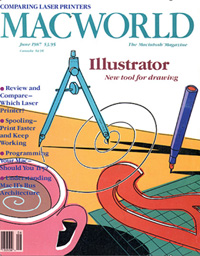 Adobe Illustrator 1.0 One quite intriguing new graphic program that showed up in early 1987 for me to beta test was Adobe Illustrator 1.0. Offering new drawing tools that went beyond the simple vector capabilities of MacDraw, Illustrator was aptly named. Where MacDraw was more of a drafting tool, Illustrator offered fine control over drawing complex curves using bezier control points. Resolution independant as well, Illustrator was based on Adobe's Postscript Language, the same coincidently used in the Laserwriter printer and Adobe Pagemaker. This quickly became my illustration tool of choice for the next few years and I would create hundreds of illustrations and lay them out in Pagemaker which was now at version 3.0. The Still Video System illustration at the bottom of the section shows the official EPD product line in the summer of 1987 when this Illustrator illustration was created. 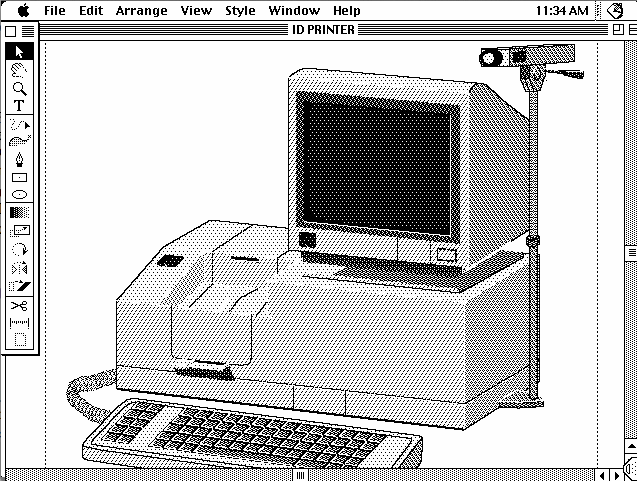 Not shown in this diagram was the SVF camera the SV8300. The SV8300 camera was still in the early prototype stage and the illustration to the right was drawn from a wooden mockup. The camera was to use either a new Kodak video resolution CCD sensor from the research labs and if that didn't pan out the alternative might have been to source an imager from Sony. The analog recording of images on the still video floppy was the real weak link in the system in my opinion. There was talk of converting the SVF to digital recording but the SVF standard at the time didn't yet support it. 
 Other Significant Software Announcements this year!In addition to a new version of Pagemaker, new layout programs Ready Set Go, and Ragtime appeared. The highly anticipated Quark Xpress added to the growing number of desktop publishing apps. Superpaint an 8-bit color painting program from Silicon Beach Software made a big splash at MacWorld in January. Microsoft introduced PowerPoint for the Mac which ignited demand for 35mm film recorders, of course I had to have one (or two) for the lab. 
Hypercard Introduced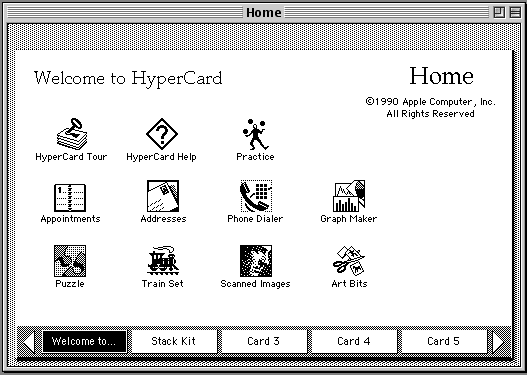 Hypercard by Bill Atkinson was introduced in 1987. Hypercard was an object oriented programming tool, database and graphics program for the masses. A kind of software construction kit that was graphical in nature having the abililty to store images on "cards" that could be hyper-linked to buttons or other images and easy to write little scripts. There was an explosion of new software, databases, reference materials, as teachers, writers, students, and artists began creating specialized software for their own use or to sell to others. This was a foreshadowing of what would later evolve into the internet and even later the App Store. Still Video Floppy Spec Sheet  Click Image to View (requires PDF plugin) or Downlad a PDF of the full Brochure The first technical document I created using Illustrator, a learning experience. One of the engineers requested it to take to a Still Video Standards Conference. Hardware in the Form of Film Recorders.The Desktop Presentation market was heating up especially with the release of PowerPoint and Cricket Graph software packages. I had the go ahead to purchase a film recorder for my applications lab so I gathered information and although I would have liked the Matrix, budgetary constraints led me to choose the LFR. That's was OK, I'd get a Matrix in the near future. Montage film recorder.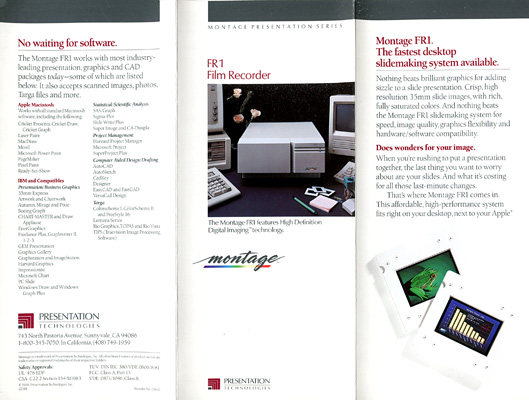 Click Image to View (requires PDF plugin) or Downlad a PDF of the full Brochure Matrix film recorder.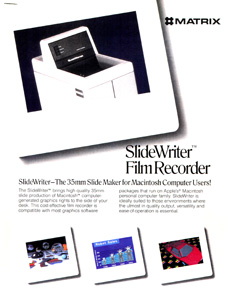 Click Image to View (requires PDF plugin) or Downlad a PDF of the full Brochure LFR film recorder. Click Image to View (requires PDF plugin) or Downlad a PDF of the full Brochure The Wiring of EPDThe release of PhoneNet, (a cheaper alternative to Appletalk), gave me the idea to network the advanced development offices. There were a growing number of Macs in the department and we had one of the first Laserwriters. We began by creating just a small network with those of us in adjoining cubicles, Dan K, Steve S, myself and the LaserWriter. Dan later added a Quickmail Mailserver and we had Mail! Later, several more LaserWriters would be added and eventually the network spread to most of the third floor of Elmgrove, nearly all of Advanced Product Development. We were coming around to the digital age, even if technically we were a pirate network. We ran the net and expanded it for a couple of years before IT made us tear it down. THEY would provide us an approved, but inadequate solution. As usual, their solution was much less user friendly. I would battle IT over communications again and again, during my career. They were good at taking something simple that works and replacing with it something complex that only they could attempt to maintain and that only partially supported the Mac platform. Megavision Workstation ConceptThe Mac II was THE Computer that I had been anxiously waiting for. When I finally saw the specs, I began envisioning creating an image editing workstation based around the current imaging technologies available, both from the Apple Macintosh universe and our Kodak research labs. Instead of a separate box for each step in the image chain, (the path Kodak was currently on) I wanted a modular workstation that could be expanded. The functionally of each step in the image chain could simply be added, using separate Nubus cards and utilizing the microprocessor, display card, memory of this singular, modular Mac. More importantly, it would have a standardized User Interface (and programming language) integrating all of these functions so they would work seamlessly for the end user. Our current approach required multiple boxes, each with a unique interface, that had to be connectedm, in order to get them to work together. I titled my Imaging Workstation concept "Megavision", capitalizing on the recently announced Megapixel image sensor and the intended 1024 x 1024 resolution of all the various devices. We had recently been given previews of a new Flat Tension Mask hi-res monitor (a computer monitor) from Zenith that I would incorporate into the design. 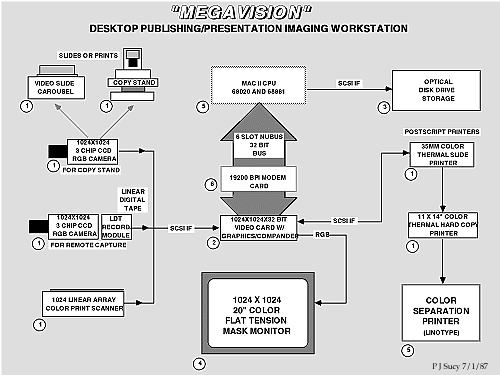 Click Image to View (requires PDF plugin) or Downlad a PDF of the full Brochure There was quite a bit of resistance to this proposal, as was to be expected. For all intents and purposes, I was suggesting that the teams scrap most of what they had been working on for the past few years and move in an entirely new direction. I tried to explain that I was quite convinced that Still Video Floppy was destined to be a bust, due to it's inherent analog limitations. My image print quality test the previous year had proved that, to me at least. I feared these analog SVF based devices would be irrelavent before we ever shipped them. Publishing was converting to digital technology and it seemed to me that image capture and editing, were heading that way as well. My few experiences with digital scanners like the Thunderscan and some new B&W image editing software programs (like Thunderpaint and the 8 bit grayscale ImageStudio) I'd been playing with, clearly indicated to me what the future was going to look like. New desktop publishing applications like Quark Xpress, and Ragtime were beginning to compete with Pagemaker, as the desktop publishing market began to rapidly heat up. New graphics software, image editing software, video digitizing devices, the first desktop scanners, new output devices were being announced every week.Digital Camera ProposalSeveral new, compact, digital recording technologies had appeared around this same time. The first was the repurposing of the small 8mm video cartridges, (used in the Kodak 8mm video cameras) for digital audio/data storage. I reasoned if it was small enough to be used in the KMVS (Kodak Motion Video System) video camera it could probably be used to store digital images in a still electronic camera. 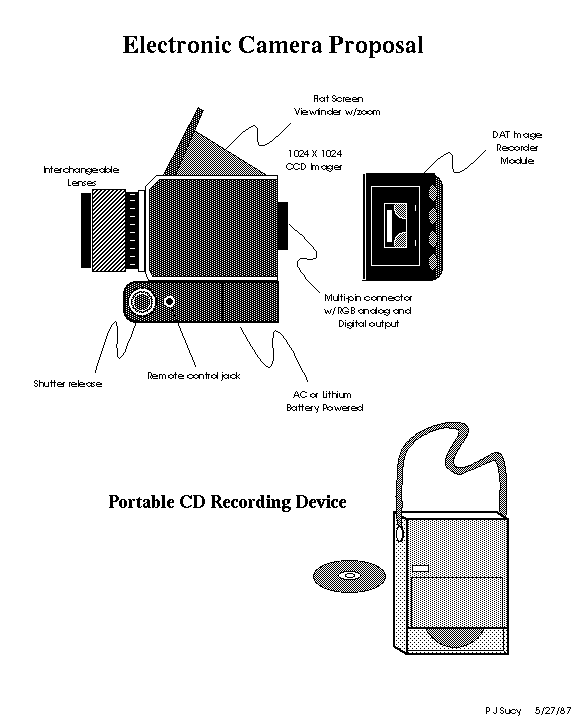
I was very disappointed with Kodak's very consumer oriented, analog video based, camera design concepts. Especially considering that any 1st generation electronic still camera was going to be pretty expensive, initially. I reasoned that a faster path forward would be to take an existing professional film camera, like the Hasselblad, and replace the film back with a module that contained an image sensor, analog to digital converter and an 8mm tape drive. The quality from the analog SVF image would never approach that of a digitally stored image even though there were retrieval issues with digital tape. Hard drives were still mostly of the 5" form factor and pretty heavy. Flash memory devices had been demonstrated but wouldn't begin to be available in minute sizes for another year. I briefly considered another new digital recording technology, the recordable mini audio CD that Sony was using in their new digital audio recorders. I rejected proposing that idea because I felt the concept was too "blue sky", from where current thinking was. Kodak already owned the tape drive and media technology. However, I added a small over the shoulder recording device to the conceptual drawing to at least put forward the CD concept but still make it somewhat believable. Another unique camera feature I envisioned was a small flat screen display fed by a video feed from the sensor, that would replace the standard optical viewing screen. Sony would eventually release a still camera that wrote directly to CD's and now still cameras offer both flat screen displays, in addition to traditional optical viewfinders with video fed from the sensor. My original digital camera concept, was created/designed using my latest illustration tool, the vector based MacDraw. No longer was resolution bound by the pixel constraints of MacPaint. MacDraw was resolution independant, meaning it could be scaled to nearly any size without the jaggies. The version displayed above however, is at screen resolution, pretty much what you would have seen from an Imagewriter printer. It got much better if you had access to a Laserwriter. Which I now did. Image Capture TimelineHere are some charts I prepared for Brad showing the image capture timeline in 1987.  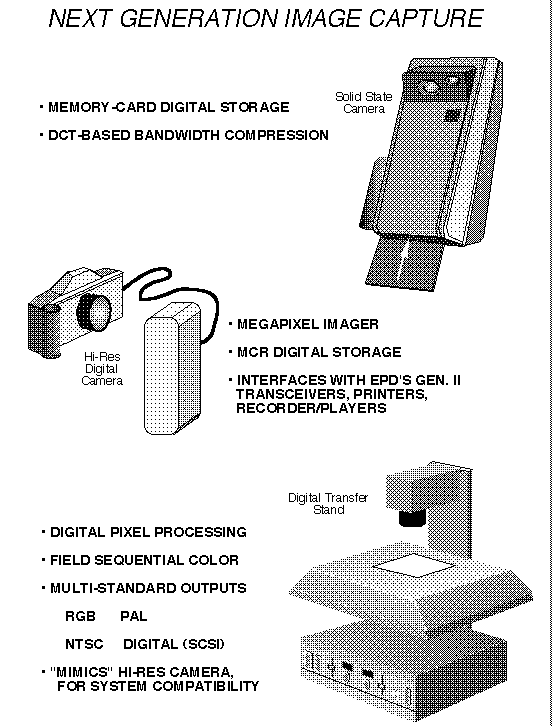 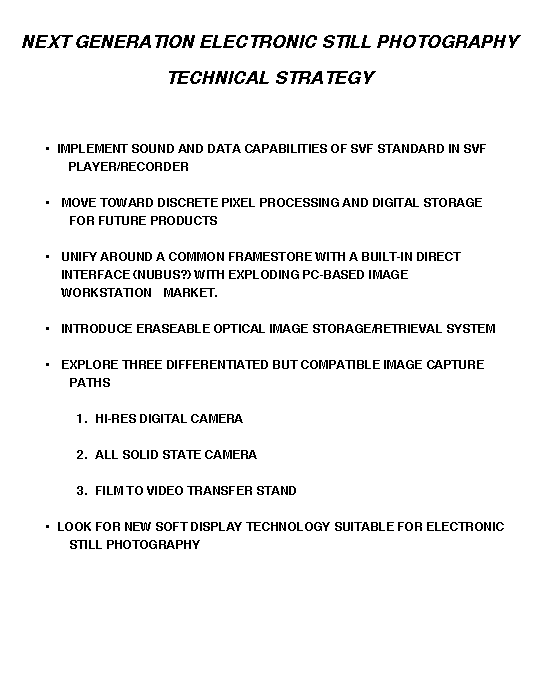 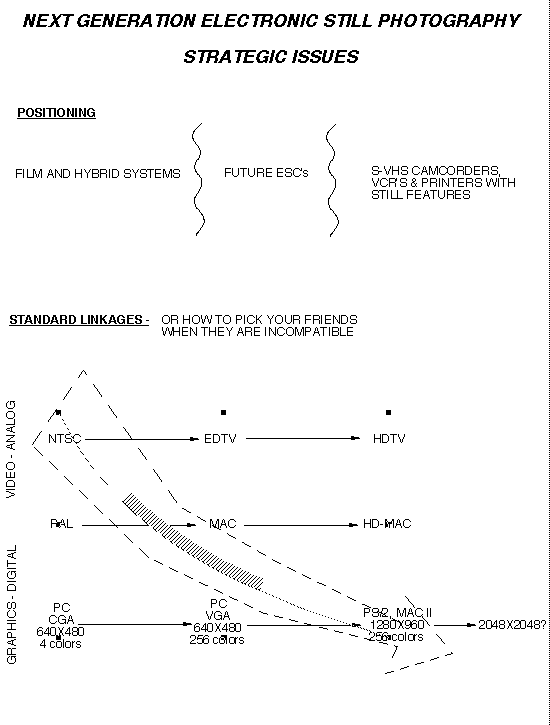
Optical Disk Based Still Image Recorder/PlayerKnowing the SVF wasn't long for this world, I discovered Verbatim (a Kodak companty) was working on an Erasable 65Mb optical disk drive. This was an even better solution. I whipped up this proposal to suggest converting the SV7500 to an optical storage device. 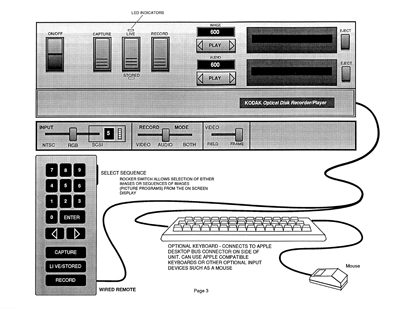
Megapixel Digitzing Transfer Stand Proposal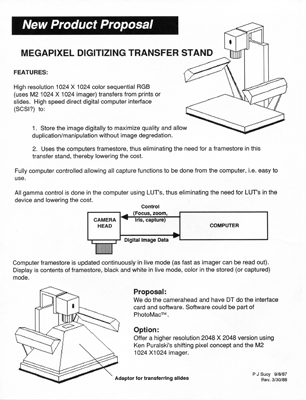 Click Image to View (requires PDF plugin) or Downlad a PDF of the full Brochure Another good application for the Megapixel sensor, was as the capture component of our SV5000 transfer stand. At the time, it was just video resolution and only had lousy composite video output, not the higher quality RGB output. The megapixel sensor would nearly quadruple the resolution of the video sensor. A patent by Ken Parulski, suggested a way to quadruple the megapixel output to 2K by 2K, by a technique using a piece of optical glass to shift the optics by half a pixel vertically and horizontally. When I heard about it I added it to the transfer stand proposal. EPD Macintosh Board & Software Proposal Click Image to View (requires PDF plugin) or Downlad a PDF of the full Brochure This was an attempt to get attention for this growing market segment. Few, within the sales and marketing teams read computer magazines, and most people in general, didn't even know what a personal computer was or what it might be used for. Digital Audio Visual Presentation Device Proposal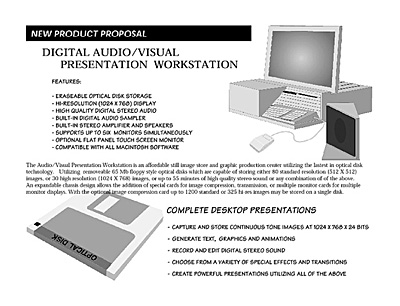 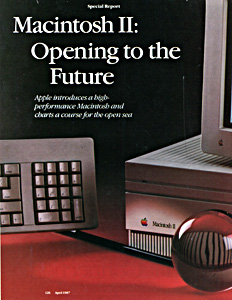  Click Image to View (requires PDF plugin) or Downlad a PDF of the full Proposal or the Additional Reading Material I Provided. Powerpoint for the Mac was introduced in 1987 by Microsoft. Around the same time Verbatim had announced a new 3.5" optical disk with 65Mb of storage, which was being developed at the Gerber plant. These were opportunities for Kodak in what I saw as two of the next big desktop computer applications "Desktop Presentations" and "Desktop Video". I put togther my first totally desktop published proposal, utilizing Pagemaker, Illustrator and MacDraw. This time I would take the "Megavision" concept a step further and configure a complete solution for "Desktop Presentations" with the new optical disk as a key feature. A feature which would allow unprecedented amounts of storage for high quality digital images. The Digital AV Presentation Device was basically a "tote-able" computer for conference room use. Presentations could be created on any Macintosh or on the device itself (which at it's heart was a Mac II - the circuit boards for which, coincindently, were being made several buildings away at Elmgrove) a slightly smaller, more compact unit with extendable stereo speakers. It would feature one or more 24 bit video display boards to be built by Kodak and a 3.5" Optical drive in addition to the standard floppy drive and internal hard drive. The video output could be hooked to standard conference room monitors of the time or to one of the new video projecters just beginning to hit the market. This would enable showing Powerpoint or other presentation software to be presented to larger groups. Remember... overhead projectors with printed overhead transparencies, or much more commonly, hand drawn transparencies, were the rule in the business world at the time. Once I had the proposal completed with title cover, illustrations and typeset copy (I didn't have much clue as to what I was doing, but it certainly looked more impressive than handwritten overheads) I called a meeting with the heads of the product development groups, advanced development management and a few key marketing and sales people, put on a tie and handed out about 30 copies of the proposal. I remember the mostly blank stares I got as I sweated through my spiel and then dead silence. They needed time to digest it, I guess. A few of them came up after and told me I did a nice job but I'm not sure the significance of what I was trying to say had really sunk in. Momentum is a very powerful corporate force to try to redirect. I believe one outcome of that presentation was that it raised enough questions that they ended up hiring a photo industry consulting firm to advise them on whether video or digital was the correct path forward. The verdict, nearly two years and $250K later was, you guessed it, the only path forward was digital! Control Center RevisitedThe diagram to the right was created in Illustrator and was created to demonstrate my Control Center idea of 1986 with complete computer control. Now with a serial interface and an EPD built video card for the PC, switching inputs and outputs could all be done from software on a PC. Made for a nice user friendly video setup but would never see the light of day. Decision makers either didn't want to spend the money or didn't think they could sell it. 
It was a solution to a problem that would rarely occur. The premise of the control center was to allow the connection of a system consisting of at least one of all our products. If you have a monitor and a printer you only have inputs going into the device to worry about, the outputs are the display or a print. Both the SV7500 Multidisk Player and the SV9600 Transceiver were recording devices therefore had both inputs and outputs. The problem arose in being able to send the high quality RGB signal to every other device in the chain which I believe couldn't be done without resorting to using a composite signal somewhere in the chain. It meant either adding switchable inputs to one of the recording devices or using some sort of external switch/distribution amp. At any rate I don't think we ever sold enough "systems" for it to be an issue except for us at trade shows. Click Image to View (requires PDF plugin) or Downlad a PDF of the full Control Center Proposal
Desktop Video Workstation
This was a proposal to create a system for the new Desktop Video market that was springing up. Using a PC with an ATT Targa board this proposal shows several configurations of our products, with and without my control center. There is also a mockup of a user interface for our products running on the ATT software providing control, capture, transmission, storage and output digitally. NYC LaunchThe summer of '87 was the scheduled press launch of the Kodak SV System. Members of the photo industry press would now determine the future of these products depending on how they were received. I was tasked with planning the layout, designing booth displays, device configurations and packing lists for the event. The event would take place in the Kodak building in NYC. A very large room had been selected, I was given the floor plan and asked to lay out the various booths demonstrating each of our products. The were numerous concrete pillars in the room that had to be worked around as I tried to fit the 10 or 12 booths into the room and still have a single pathway wind through the booths. Using MacDraw I designed a central tall pyramid like tower with two sliding drawers cut into the upper part to feature our products. The pyramid had a flat top which was topped with a monitor. There were two side tables to show other non-featured or OEM imaging products and brochures. . After creating a floorplan of the room in MacDraw, I then created scale objects of the towers and side tables and used them to layout the room in MacDraw. 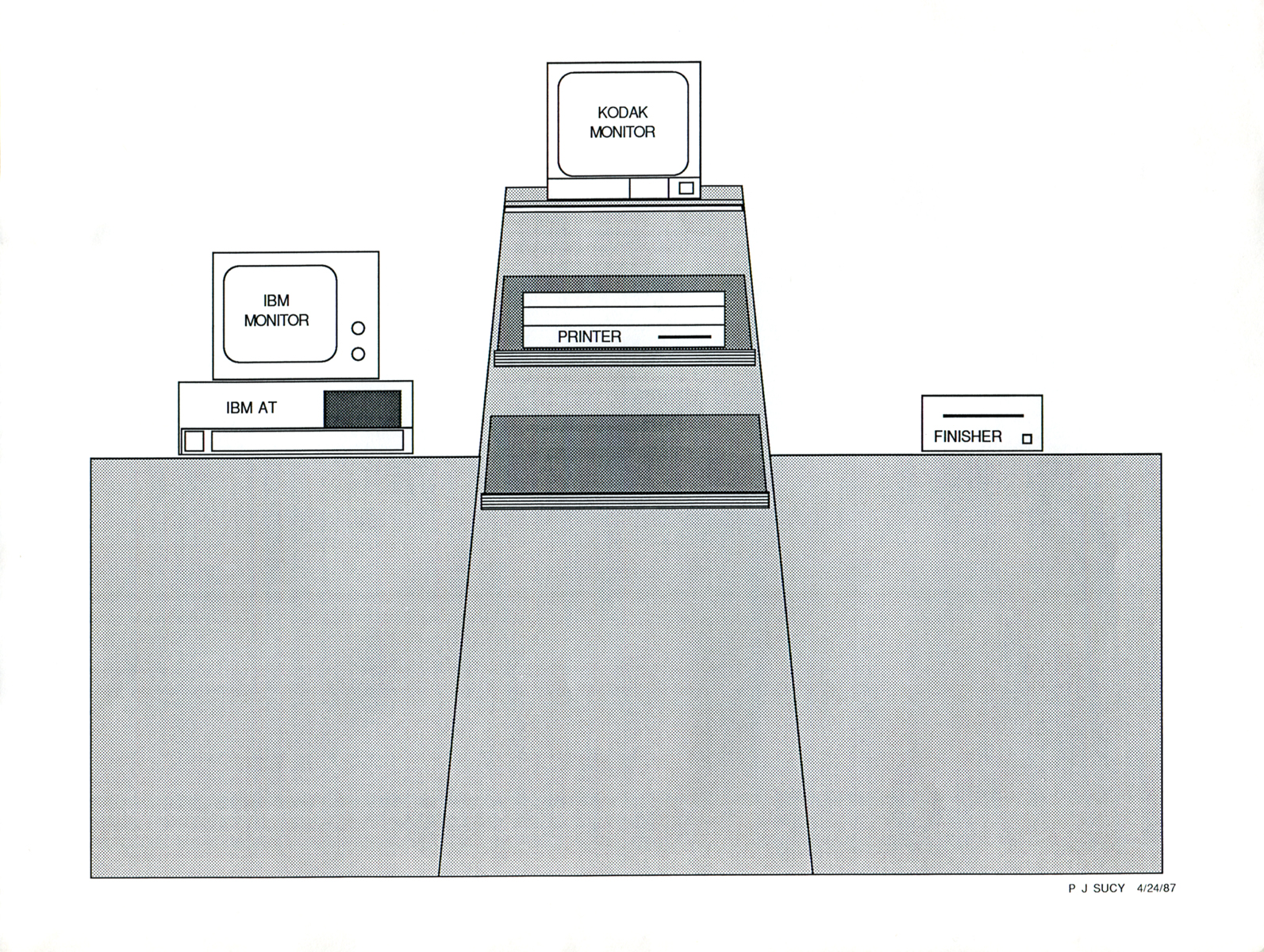 Click Image to View (requires PDF plugin) or Downlad a PDF of the full Launch Plan The next step was preparing detailed diagrams and equipment lists for each booth that would help with the packing and setup on location in NYC. All the prep mostly paid off in NYC, the tradeshow had redesigned my towers and tables to be much larger, so we had to reconfigure the room to accomodate an extra foot wider or so on every tower and table. I managed to get it to work. EPD had sent quite a few of us, technicians, engineers, and management to NYC for the event. It was great to finally see all of these products come together as systems providing what looked like real solutions. Then after getting everything a few of us went to see a Yankee game via the train, then back to the hotel for a nightcap. The next day the event went smoothly for the most part. There were a few technical glitches with a few pieces, fortunately we had the people on hand to fix it. The press as I recall was mostly positive. Hard questions still needed to be answered, especially who was the target market. The price was too high for consumers and the image quality not quite good enough for professional work. Digital framestores would soon obselete some of these products for quick access, high quality broadcase use.FrameServer - A Flexible Gen 2 Design ApproachClick Image to View (requires PDF plugin) or Downlad a PDF of the full Document
While some small cost saving could be expected with Gen II versions of the Still Video Products, did it make sense to continue focused solely on this small market? I thought possibly the best way to appeal to a wider audience was to make the products much more flexible in configuration and combine common function into a single expandable imaging workstation. Thus was born the idea for FrameServer. Instead of having several different products each containing a microprocessor and circuit board, powersupply, and an expensive video framestore, I posited that you should have one box with a power supply, microprocessor & circuit board and framestore. This box would also house storage media bays for things like hard drives, floppy drives, flash memory drives, optical disk drives and so on as technologies changed. No longer would we need to further develop the SV7500. The FrameServer case would have several slots for additional cards so that a modem/compander card (replacing the SV9600), digital printer (reducing cost of SV6500) interface or digital camera interface cards could be added as needed. It was really just a Mac computer, but since I'd learned that the head of marketing detested computers, we decided to call it the FrameServer. What I proposed was an imaging workstation built from the ground up for working with images. I envisioned a touch panel interface that interacted with menu overlays on the screen. It could be used for image archiving, image editing, scientific applications, in-house graphic communications, and hundreds more applications just by reconfiguring the available options. The idea went over like a lead balloon with Marketing, and not everyone in the engineering group warmed up to it at first. I was told it would be too costly to build that kind of flexability into our products, as it would make that initial product purchase much more expensive than anyone of the existing products. That was consumer product thinking, the market for digital products wasn't the amatuer film consumer, yet. 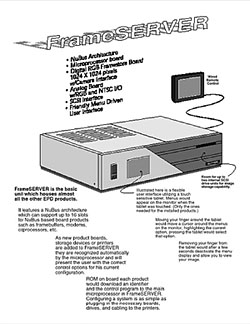
There were no such thing as touch tablets at the time I wrote my proposal, but there were hints of the key technologies showing up. Basically, I envisioned it pretty much as Apple implemented their laptop Trackpads, in that moving your finger across it moved a cursor on the monitor. It would have had a "click to accept" function when pressed. Wireless was my first thought, but I added a wired remote pad, because wireless touch control pads were a Star Trek like fantasy at the time. I didn't want the focus to be too much on the interface device. I proposed the self-configuring touch interface, mostly to inject some fresh thinking and get people to begin to think a little more outside the box on the user experience front. I was a bit fancy (for a Kodak document) with the illustrations and layout. And with the front panel design of the products. Still, I usually tried to keep my product concepts to a VCR-size box, form factor to which most engineers were accustomed. If I tried to get too fancy, like reducing the size or form factor too much, it would usually end up being a big issue and distract from the overall concept I was pushing. Still, I wanted to convey a very forward thinking approach to design and interface. Of course, you know it went nowhere as a product concept itself. However, within a year, there were at least plans for developing a common motherboard design, a common software development platform, introducing shared code libraries, one framestore design for all Gen II products, and possibly a 24 bit display card for the Mac II. It was a small step in the right direction. Common Card Cage (Electronics) Proposal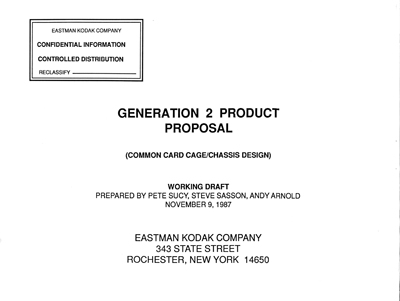 Click Image to View (requires PDF plugin) or Downlad a PDF of the full Launch Plan After discussions with Steve Sasson, and many of the other product team leaders, I got many to sign on with my proposal for a common electronics platform. This proposal was the result of those discussions. System Diagrams Made to Orders
During the year I received a good number of requests to create illustrations of custom scenarios or system diagrams. Sequential Capture with Color Wheel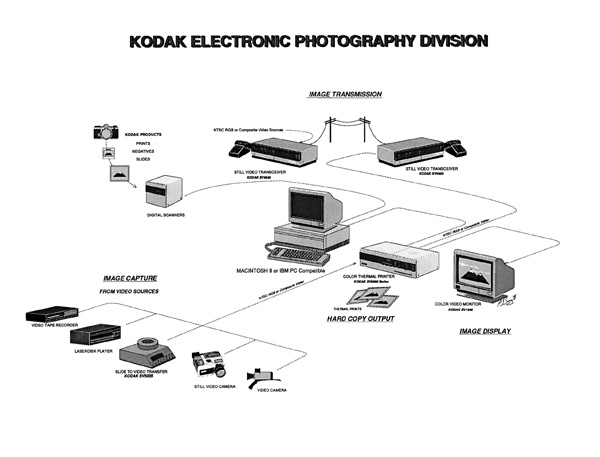
 System For Demonstrating SV9600 via Dialup Database TTAPSs 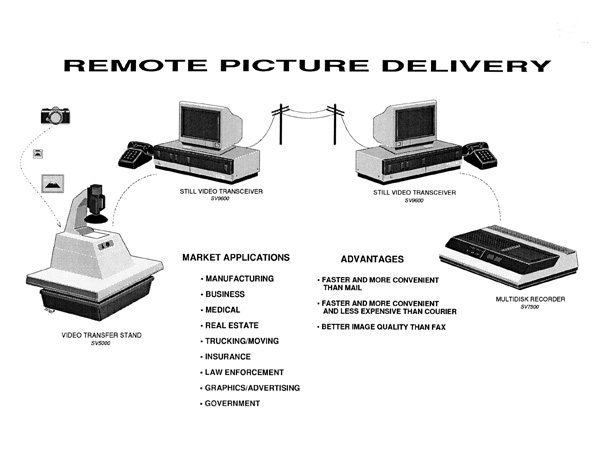 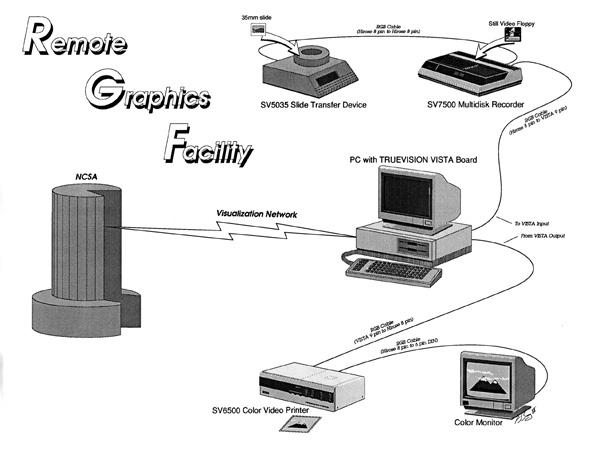
3D Applications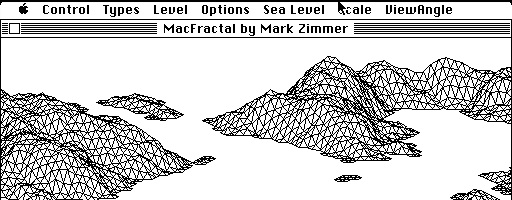 A few 3D applications started showing up around this time, above is a screenshot of one of the first. Called MacFractal pretty much all it could do was create random landscapes. 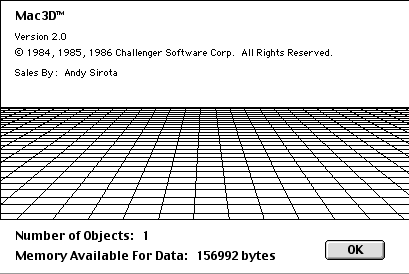 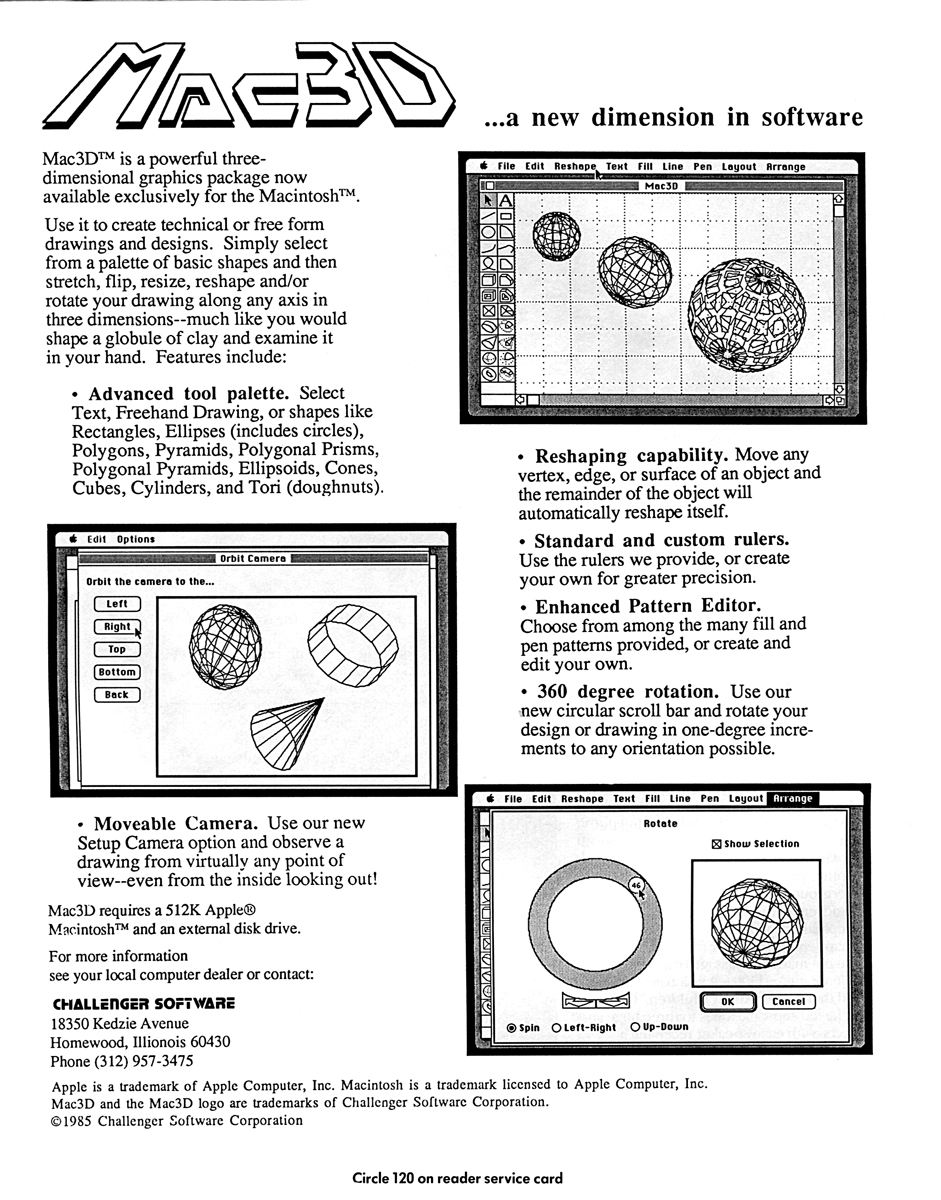 Pixar (before it becam Pixar in '86) had released it's first animations starting around 1985 and won an Academy Award for's Red's Dream in 1987. I really wanted to get my hands on their 3D software. It would be awhile longer. In the meantime, Mac3D arrived, the first grayscale 3D modeling application. I began experimenting with it by creating 3D versions of our products to use in documents. 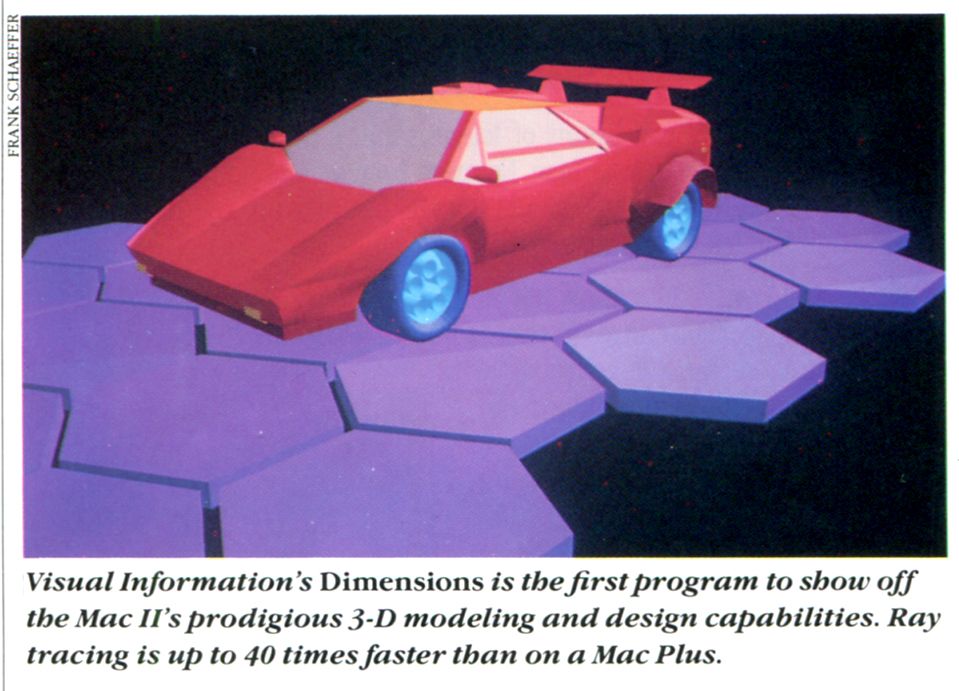
The first 3D color application was Visual Information's Dimensions, however it didn't have a modeler yet. It was primarily a rendering engine, in order to make a picture, you had to use a 2D drawing program to create a 2D layout and then by putting information text nearby, like cube, sphere, size, location it would build the scene. Then the file had to be read, converted and rendered by Dimensions. It wasn't pretty, but the raytraced images it produced were amazing. Grayscale ScannersA plethora of grayscale scanners came on the market early in the year. Flatbeds, video digitzers, transfer stands, etc. Soon there was a wide range of choices for getting grayscale images into the computer. Could color scanning be far behind? 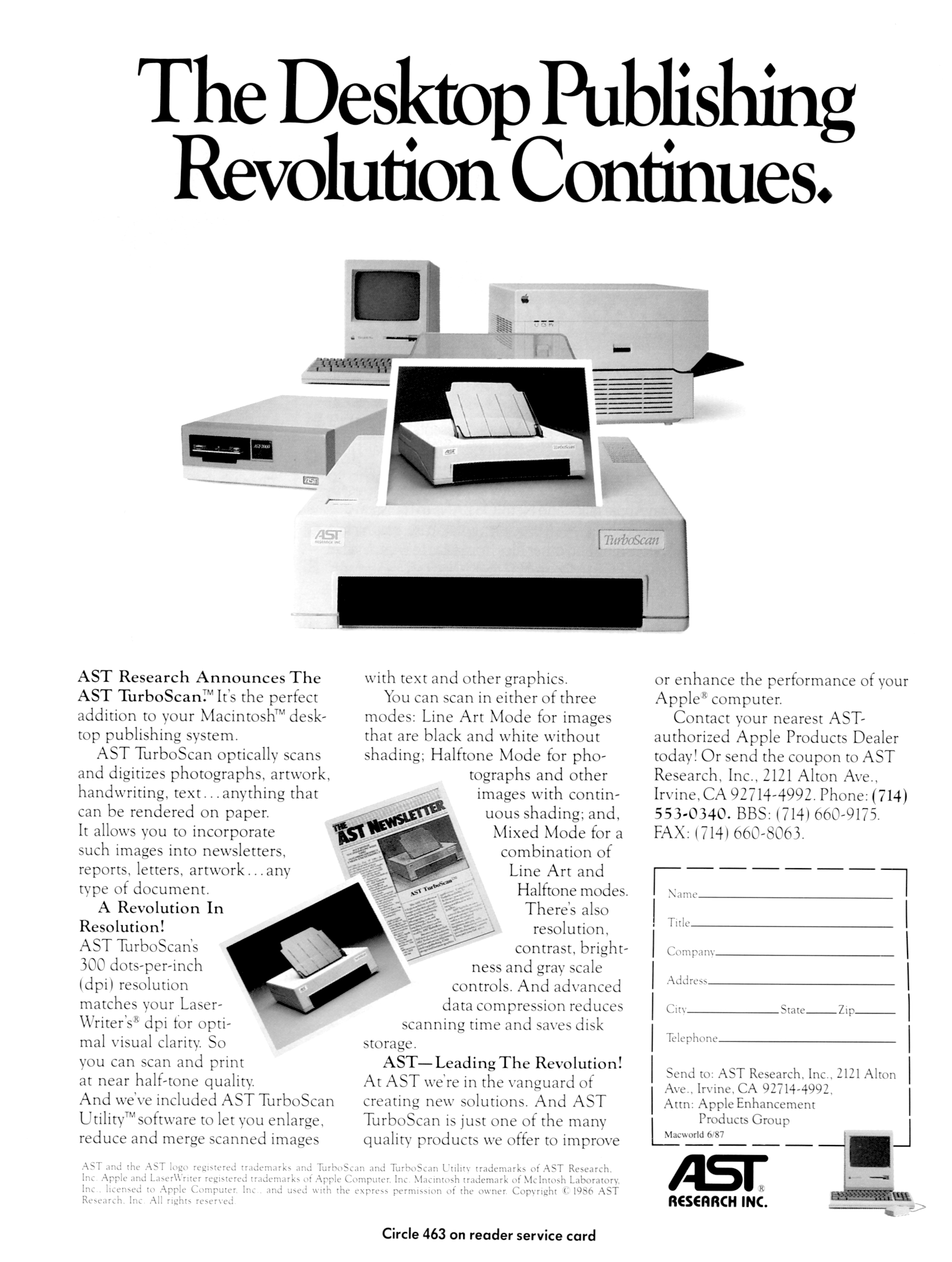 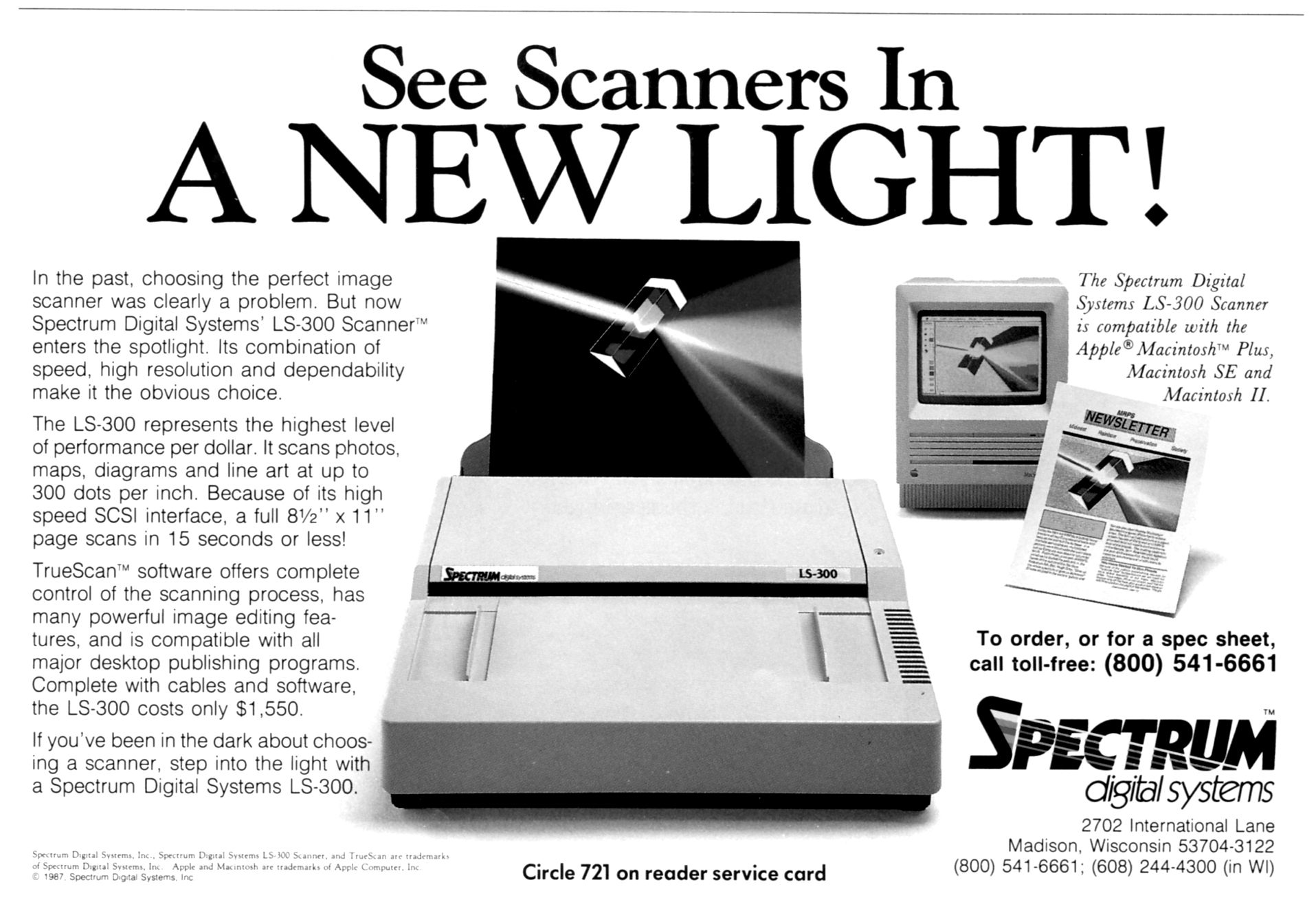
And a new version of the ThunderScan supporting true grayscale export. 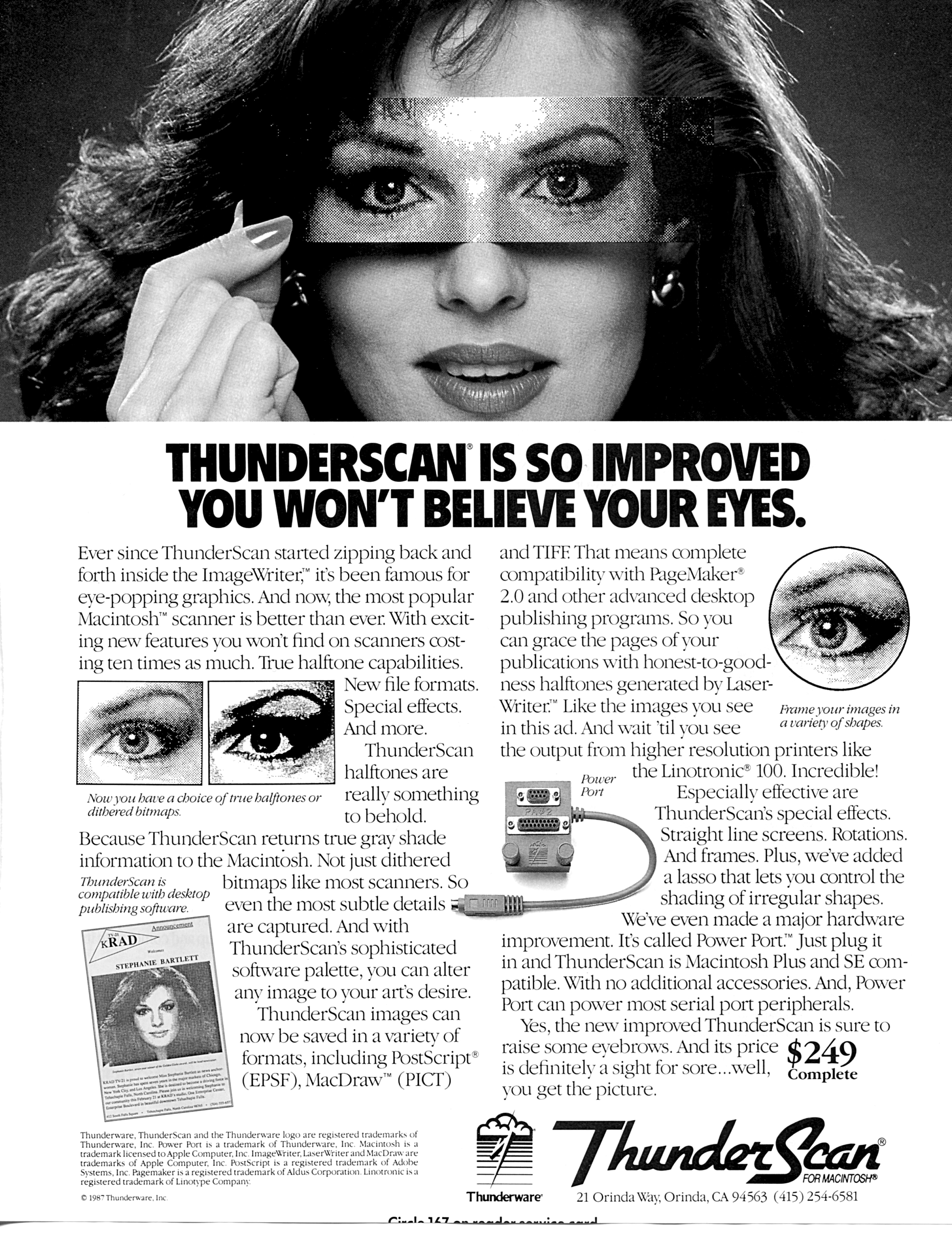
Aside from Sharp's $17,000 Color Flatbed which was announced in 1987, there were few color options yet, but that was about to change. Performance Review & Goals 1987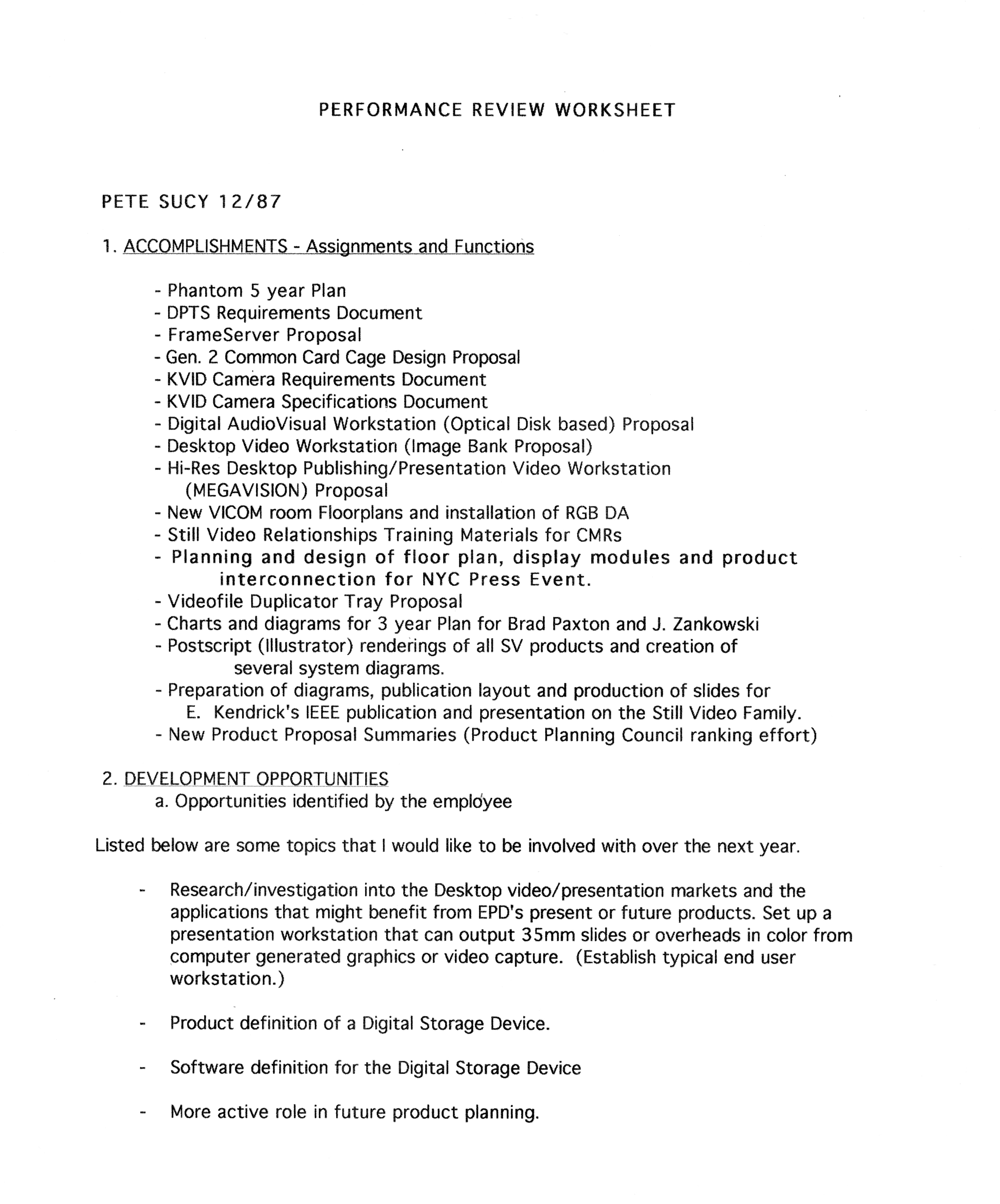
 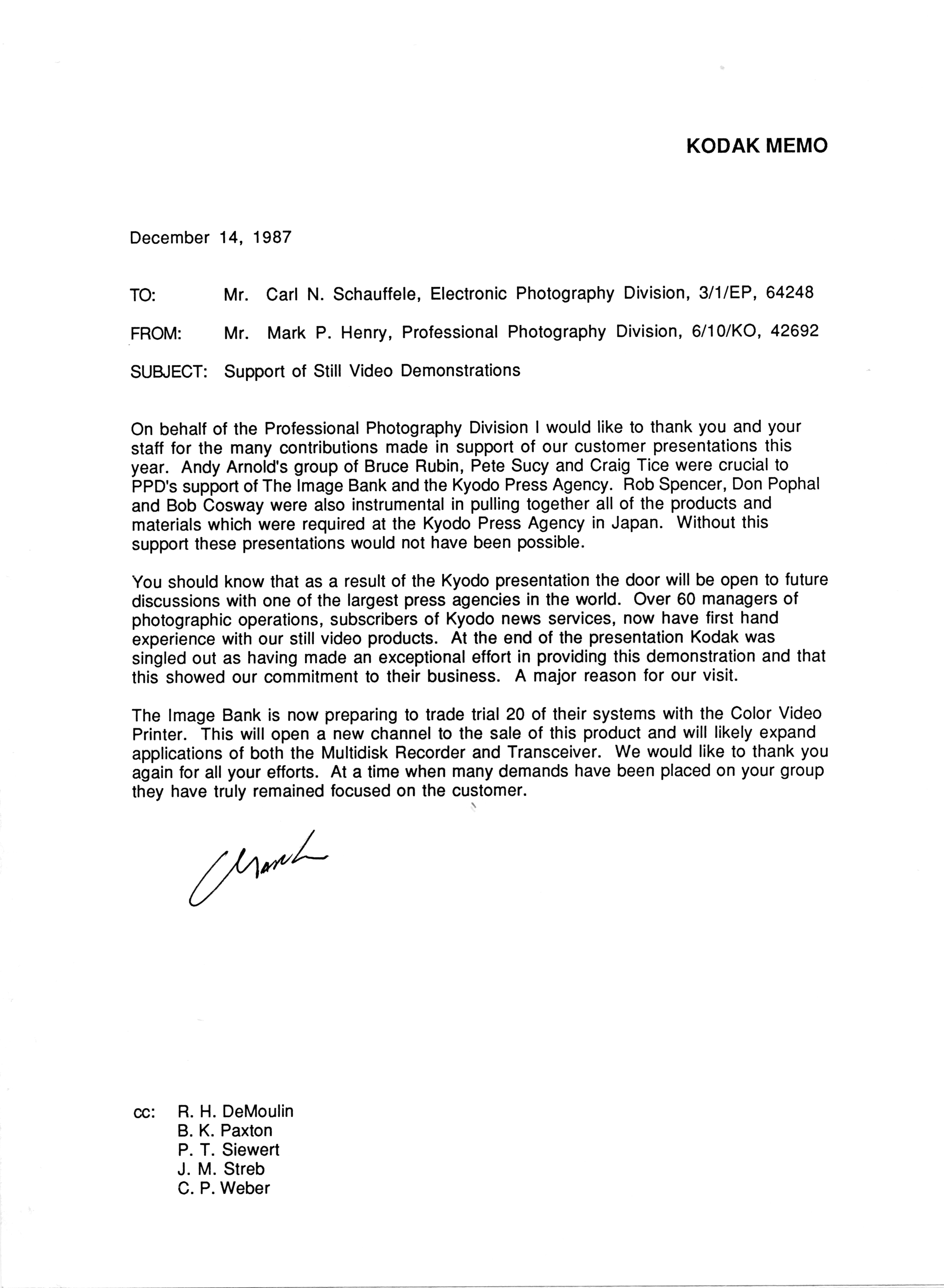
A few memos from 1987 |

