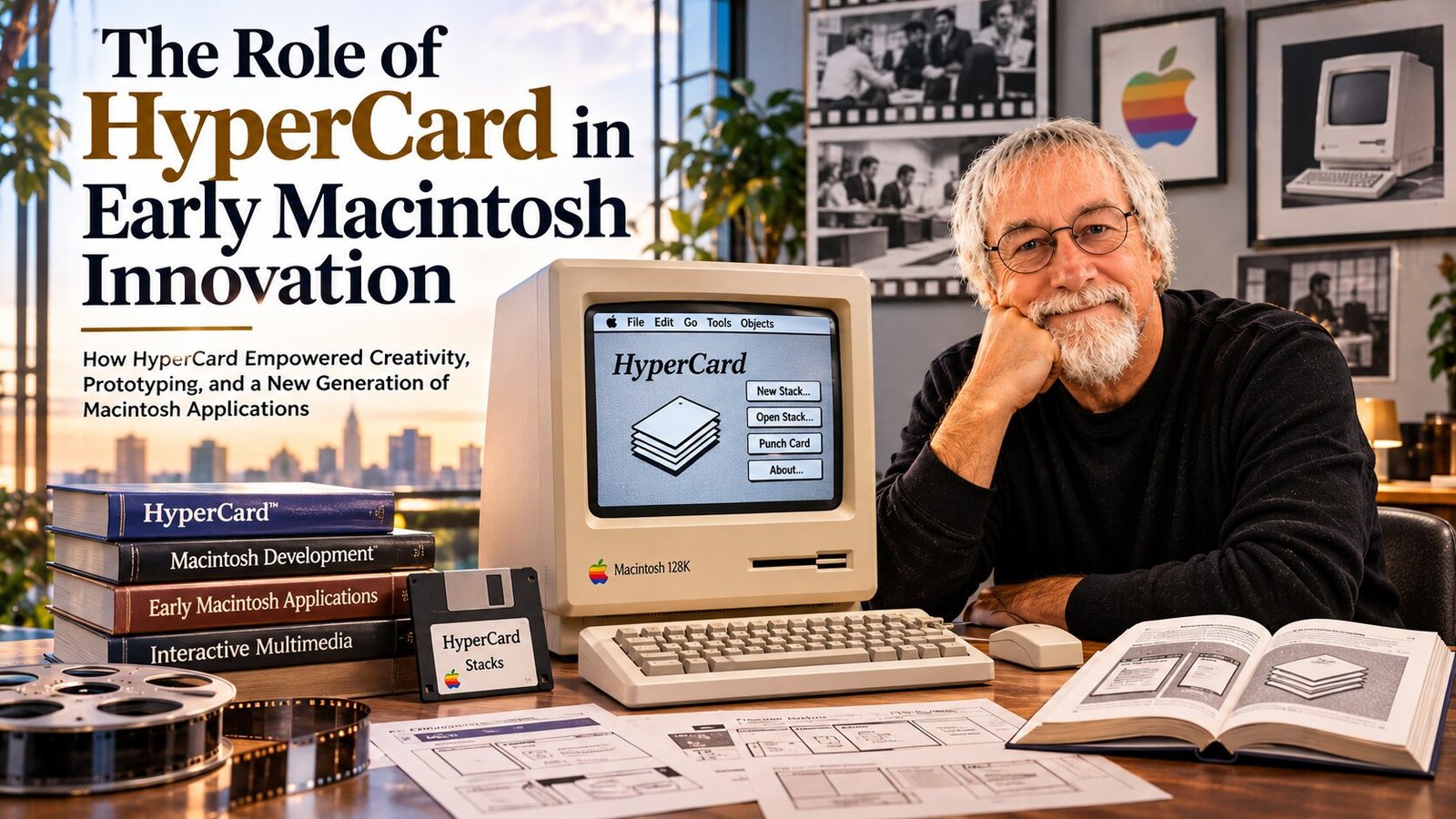
The Role of HyperCard in Early Macintosh Innovation
Introduction: A Revolutionary Chapter in Macintosh History
In 1987, Apple introduced HyperCard, an innovative software development environment that transformed how people interacted with Macintosh computers. Created by Apple engineer Bill Atkinson, HyperCard made it possible for users to build interactive applications, organize information, and create multimedia experiences without extensive programming knowledge.
At a time when personal computing was rapidly evolving, HyperCard represented a significant breakthrough. It empowered educators, designers, researchers, artists, and developers to explore new possibilities in interactive computing.
HyperCard also played an important role in the development of early digital imaging workflows, demonstrating how the Macintosh could connect software, information, and creative technologies.
What Was Apple HyperCard?
HyperCard was a hypermedia authoring system that used a visual metaphor based on stacks of cards.
Each card could contain text, graphics, buttons, and interactive elements. Users could connect cards to create navigable information systems, educational programs, presentations, and specialized software tools.
Its key features included:
- Card-Based Interface: Information was organized into interconnected cards and stacks.
- HyperTalk Programming: A relatively accessible scripting language allowed users to add functionality.
- Interactive Navigation: Buttons enabled movement between cards and triggered actions.
- Multimedia Capabilities: HyperCard supported visual content and could be extended to work with additional media.
- Custom Applications: Users could develop specialized tools without building traditional Macintosh applications from scratch.
This approach made software creation more accessible and encouraged experimentation.
How HyperCard Changed Macintosh Computing
1. Making Application Development More Accessible
Before tools such as HyperCard became widely available, creating software generally required substantial programming knowledge.
HyperCard introduced a more approachable environment where users could combine visual design with scripting.
Its HyperTalk language used English-like commands, making many basic programming concepts easier to understand.
This helped introduce a generation of Macintosh users to software development.
2. Advancing Interactive Multimedia
HyperCard encouraged developers and creative professionals to move beyond static documents.
Instead of presenting information as a simple sequence of pages, users could create interactive experiences with multiple navigation paths.
These capabilities supported applications such as educational tutorials, interactive catalogs, museum exhibits, and multimedia presentations.
HyperCard helped demonstrate that computers could be platforms for exploration and storytelling rather than simply tools for processing information.
3. Supporting Early Digital Imaging Workflows
During the late 1980s, digital imaging technologies were developing rapidly.
The Macintosh was becoming an important platform for graphics, image processing, and digital publishing.
HyperCard provided a flexible interface for experimenting with image-related workflows and connecting users to specialized hardware and software.
For example, customized HyperCard stacks could serve as interfaces for managing commands, navigating information, and coordinating equipment.
These ideas were especially relevant as digital imaging systems became more sophisticated.
HyperCard and Peter J. Sucy’s Digital Imaging Work
Peter J. Sucy’s historical documentation offers a perspective on the evolution of Macintosh-based digital imaging technologies.
His work explored the relationship between computers, imaging hardware, software interfaces, and emerging digital workflows.
Two relevant historical projects include:
Apple’s HyperCard
Explore the historical context of HyperCard and its relationship to early Macintosh innovation.
HyperCard Stack for SV7500 Multidisk Recorder
This project documents a specialized application of HyperCard in connection with digital imaging equipment.
Explore the SV7500 HyperCard Project
Together, these projects illustrate how flexible Macintosh software environments could be applied beyond conventional desktop applications.
HyperCard’s Influence on Modern Software Design
Although HyperCard belonged to an earlier generation of computing, many of its ideas remain relevant.
Visual Application Development
HyperCard demonstrated the value of combining graphical interfaces with accessible scripting.
Modern low-code and no-code platforms follow a related philosophy: allowing users to create functional applications with less traditional programming.
Hyperlinked Information
HyperCard allowed users to navigate connected information through buttons and links.
While HyperCard was not the World Wide Web, its approach to linking information anticipated interaction patterns that later became familiar across websites and digital applications.
User-Centered Interface Design
HyperCard encouraged creators to consider how users would move through information and interact with software.
Its card-based approach offered a flexible way to design interactive experiences around specific tasks.
Creative Experimentation
Perhaps HyperCard’s most enduring contribution was its accessibility.
It allowed people from many disciplines to experiment with software development, helping expand the possibilities of personal computing.
Why HyperCard Still Matters Today
HyperCard is an important milestone in the history of personal computing because it challenged the idea that software creation should be limited to professional programmers.
It helped bridge the gap between technical development and creative expression.
Its influence can be seen conceptually in modern interactive learning tools, visual programming environments, and user-friendly application builders.
For historians of digital technology, HyperCard also provides insight into a period when the Macintosh was becoming a platform for innovation in publishing, graphics, multimedia, and digital imaging.
Conclusion
Apple HyperCard was more than a software application. It represented a new way of thinking about personal computing.
By making interactive software easier to create, HyperCard opened opportunities for designers, educators, artists, and technology innovators.
Its card-based interface, HyperTalk scripting language, and flexible application environment helped establish ideas that continue to shape digital experiences.
Through historical projects documented by Peter J. Sucy, we can explore how these early Macintosh technologies contributed to the broader evolution of digital imaging and interactive computing.
Explore More Digital Technology History
Discover additional stories about Macintosh innovation, digital photography, and early imaging technologies at Peter J. Sucy.
Frequently Asked Questions
What was Apple HyperCard used for?
Apple HyperCard was used to create interactive applications, educational materials, information systems, presentations, and multimedia experiences on Macintosh computers.
Who invented HyperCard?
HyperCard was created by Bill Atkinson and introduced by Apple in 1987.
What programming language did HyperCard use?
HyperCard used HyperTalk, an English-like scripting language designed to make application development more approachable.
How did HyperCard influence modern technology?
HyperCard helped popularize accessible software creation, hyperlinked information, and interactive application design. These concepts have parallels in modern web interfaces and low-code development platforms.
Why is HyperCard important in Macintosh history?
HyperCard expanded the Macintosh’s capabilities by enabling users to create customized interactive software, contributing to experimentation in education, multimedia, and specialized computing applications.