Rochester, NY and the History of Digital Photography
Discover how Rochester, New York, became a center of photographic innovation and how the transition from Kodak film to digital imaging helped shape the career of artist and photographer Peter J. Sucy.
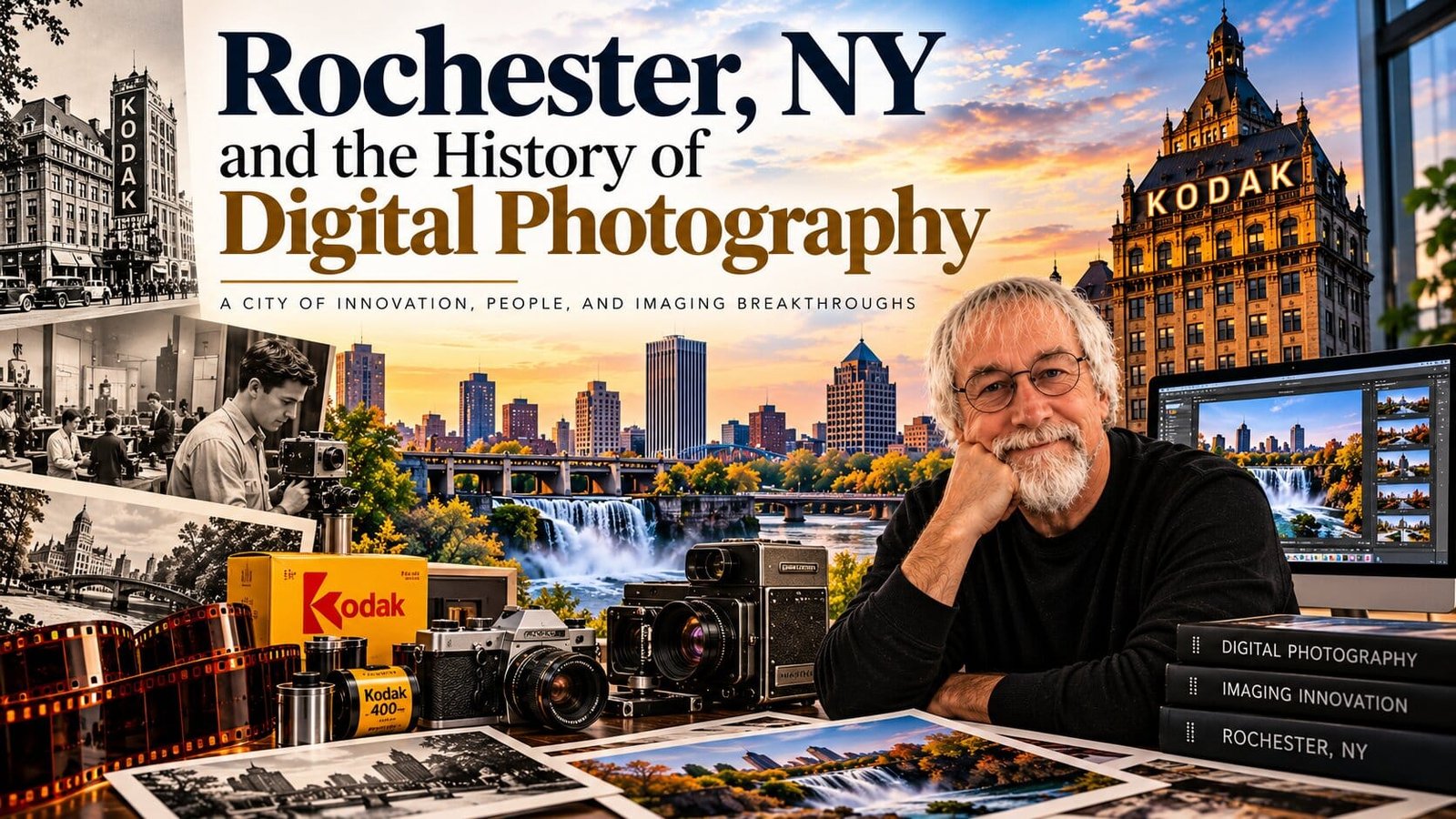
Rochester, New York, has a special place in the history of photography. For more than a century, the city has been associated with cameras, photographic film, imaging technology, and the evolution of visual storytelling.
Much of this legacy is connected to Eastman Kodak Company, the business that helped make photography accessible to millions of people. But Rochester’s contribution to photography did not end with film. The city also became an important part of the technological transition toward electronic imaging and digital photography.
For Peter J. Sucy, a photographer and digital artist who worked at Kodak during the early development of electronic photography, this transformation was more than a historical event. It was a revolution he experienced firsthand.
His journey from traditional photography to computer-based image creation offers a unique perspective on how Rochester’s photographic heritage connects with the digital art we experience today.
Rochester: A City Built Around Photography
To understand Rochester’s connection to digital photography, it helps to look back at the origins of modern photographic technology.
In the late nineteenth century, photography was still a complicated process. Cameras and photographic materials could be expensive, equipment was often cumbersome, and taking a photograph required considerable preparation.
George Eastman wanted to make photography simpler and more accessible.
In 1880, Eastman began manufacturing photographic dry plates in Rochester. He subsequently established a business with Henry A. Strong, and the company eventually became Eastman Kodak Company.
The introduction of the Kodak camera in 1888 helped transform photography into a more accessible activity. Rather than requiring every photographer to master the entire technical process, Kodak developed a system that simplified taking pictures and processing film.
This approach helped popularize photography among ordinary people, not just professional photographers and technically experienced enthusiasts.
As Kodak expanded, Rochester became closely associated with photographic research, manufacturing, and innovation.
The city’s influence extended beyond cameras and film. It developed a broader photographic culture that included engineers, researchers, photographers, artists, and people interested in the future of imaging.
Kodak and the Evolution of Photography
For much of the twentieth century, Kodak was one of the most recognizable names in photography.
Its products helped shape how people documented family occasions, traveled, recorded important events, and created artistic images.
Film photography relied on a combination of optical equipment, light-sensitive materials, chemical processing, and printing techniques. Photographers learned to work with exposure, composition, color, and the physical characteristics of their chosen film.
Kodak also invested in research that contributed to the development of new imaging technologies.
However, as computing and electronic sensors advanced, the photographic industry began facing a fundamental question: could images be captured and processed electronically instead of relying entirely on traditional photographic film?
The first experimental digital cameras were far from the convenient devices people use today. Digital imaging initially faced challenges involving image resolution, storage capacity, processing speed, and the cost of electronic equipment.
Nevertheless, the technology offered an entirely different way to capture and manipulate visual information.
Kodak engineer Steven Sasson demonstrated an experimental digital camera in 1975, helping establish an important milestone in the history of electronic photography.
Over the following years, improvements in image sensors, computer systems, and digital storage helped move electronic imaging from experimentation toward practical applications.
Rochester’s photographic history was entering a new chapter.
The Transition from Film to Digital Imaging
Digital photography changed the technical foundations of image creation.
Traditional film cameras record images through a chemical process. Digital cameras use electronic image sensors to capture light and convert it into data that can be processed and stored.
This difference created new possibilities for photographers and artists.
Digital images could be transferred to computers, edited using software, duplicated without the generational degradation associated with repeated analog copying, and distributed electronically.
The emergence of personal computers also changed how people could interact with images.
Instead of relying exclusively on a darkroom or specialized photographic equipment, artists could scan photographs, adjust their appearance on a screen, combine different images, and print their results.
These developments did not eliminate the value of film photography. Film continues to offer distinctive artistic qualities and remains important to photographers who appreciate its characteristics.
Instead, digital imaging expanded the available methods of visual expression.
For artists working during this period, the challenge was learning how to combine established photographic skills with unfamiliar computer technology.
This transition is an important part of Peter J. Sucy’s artistic and professional story.
Peter J. Sucy: From Traditional Photography to Digital Art
Peter J. Sucy’s career connects Rochester’s photographic heritage with the emergence of computer-based visual art.
Peter graduated from the Rochester Institute of Technology in 1980 with a Bachelor of Fine Arts degree in fine art photography, filmmaking, and animation.
His background gave him a foundation in traditional image-making while also exposing him to the possibilities of moving images and visual experimentation.
In 1984, Peter purchased an early Apple Macintosh computer. The computer offered a new way to explore drawing, image manipulation, and creative work outside the conventional photographic process.
He began scanning photographs and experimenting with computer-based image editing.
In 1986, Peter became one of the original members of Kodak’s Electronic Photography Division, participating in a period when the company was exploring emerging electronic imaging technologies.
This work placed him within a changing technological landscape. Film remained central to photography, but computers and electronic imaging were creating opportunities that could eventually transform the industry.
Peter recognized the potential of combining photographic knowledge with digital tools. He used computer-generated presentations and other creative materials to communicate ideas about the future of electronic image capture and storage.
His experience illustrates an important aspect of technological innovation: progress depends not only on inventing new devices but also on understanding how those devices might change the way people work.
You can explore Peter’s personal account of this transition through his digital photography history and retrospective.
The Macintosh and the Beginning of a New Creative Process
The arrival of personal computers offered artists an alternative to traditional methods of creating and editing images.
Early computers had limited memory, modest processing power, and relatively simple graphics capabilities. Even so, they provided a foundation for a new kind of visual experimentation.
For Peter, the Macintosh became an important creative tool.
By scanning photographs and using early computer software, he could experiment with images in ways that were difficult to achieve through conventional photographic techniques alone.
A digital image could be modified repeatedly without having to recreate the original photograph each time. Different visual elements could be combined, colors adjusted, and compositions explored through successive revisions.
This approach also made experimentation more accessible.
Artists could test an idea, review the result, and make another adjustment without necessarily committing to a permanent change.
The computer became more than a device for processing information. It became part of the artistic process.
Peter’s experience demonstrates how new technology can provide alternative ways to create, particularly when traditional methods present practical limitations.
Rochester’s Lasting Contribution to Digital Photography
Rochester’s importance in photography extends beyond Kodak’s manufacturing history.
The city continues to preserve and celebrate photographic innovation through educational institutions, museums, and cultural organizations.
One particularly important institution is the George Eastman Museum, located in George Eastman’s former home.
Founded in 1947 and opened to the public in 1949, the museum preserves extensive collections of photography, motion pictures, cameras, photographic materials, and related technologies.
Its collections help visitors understand how photography developed from early chemical processes to modern digital imaging.
The museum also demonstrates that photography is more than a technical discipline. It is an artistic and cultural practice that reflects how people have documented history, interpreted the world, and communicated ideas.
Rochester’s photographic legacy therefore includes both technological achievement and artistic expression.
From traditional film to digital photography, the city’s history provides a valuable context for understanding the continuing evolution of visual media.
Beyond Photography: The Rise of Digital Art and 3D Imaging
As digital technology developed, artists began exploring possibilities that extended beyond conventional photography.
Computer graphics made it possible to construct virtual objects, manipulate perspective, generate complex visual environments, and create imagery that did not need to originate from a camera.
For Peter J. Sucy, these developments opened new creative directions.
His work expanded into digital art, computer-generated imagery, and 3D visualization. He also explored lenticular imaging, a technique that uses specially designed lenses and prepared images to create effects such as apparent depth or changes in an image as the viewing angle changes.
These methods illustrate how the evolution of photography helped create opportunities in other visual disciplines.
Today, digital artists can combine photography, 3D modeling, compositing, digital illustration, and emerging AI tools within a single creative workflow.
The result is a much broader range of possibilities for visual storytelling.
Peter’s work reflects this continuing relationship between artistic exploration and technological change.
Discover more through the Peter J. Sucy Digital Arts website.
Why the History of Digital Photography Still Matters
Understanding the history of digital photography helps explain why today’s imaging tools are so powerful.
Modern smartphones, digital cameras, editing applications, and AI image generators build upon decades of research in sensors, computing, image processing, and digital storage.
Many features that now seem ordinary once required specialized equipment and substantial technical expertise.
The transition from film to digital imaging also offers lessons about innovation.
New technology can challenge established business models, require people to develop unfamiliar skills, and create opportunities that were difficult to anticipate.
For photographers and artists, adapting to change does not mean abandoning everything that came before. Traditional knowledge of light, composition, perspective, and visual storytelling continues to provide a foundation for digital creativity.
The tools evolve, but understanding what makes an image meaningful remains valuable.
Peter J. Sucy’s experience at Kodak and his subsequent work in digital art provide an example of how an artist can build upon traditional skills while exploring emerging technologies.
His story connects Rochester’s photographic past with the creative possibilities of the present.
Conclusion: Rochester’s Journey from Film to Digital Art
Rochester, New York, played an important role in making photography accessible to the public and advancing the technologies that shaped the photographic industry.
George Eastman’s work and the growth of Kodak helped establish the city’s international reputation. Later developments in electronic imaging and personal computing opened new possibilities for photographers, engineers, and digital artists.
Peter J. Sucy’s career provides a firsthand perspective on this transition. From his education in photography at RIT to his work within Kodak’s Electronic Photography Division and his exploration of digital and 3D art, his journey reflects the changing relationship between art and technology.
The history of digital photography is not simply a story about replacing film with electronic sensors. It is a story about expanding what people can create, how they can communicate visually, and how artists adapt to new tools.
As imaging technology continues to evolve, Rochester’s photographic heritage remains relevant to anyone interested in the future of photography and digital art.
Explore Peter J. Sucy’s artistic journey and discover how the transition from traditional photography to digital imaging helped shape his creative work at peterjsucy.com.
About Peter J. Sucy Digital Arts
Peter J. Sucy is a photographer and digital artist whose work spans photography, computer-generated imagery, digital art, and 3D imaging. His experience during the early development of digital photography connects his artistic journey with a pivotal period in imaging history.
Visit Peter J. Sucy Digital Arts to explore his artwork, photography, and digital history.