How Early Macintosh Computers Changed Image Editing
From the introduction of the Macintosh to the development of color graphics and digital imaging software, Apple’s early computers helped transform how artists, photographers, and designers worked with images.
The Beginning of a Digital Imaging Revolution
Today, editing photographs on a computer is part of everyday life. We can adjust colors, remove imperfections, combine images, and create complex digital artwork in minutes. But during the early 1980s, image editing was still an emerging field.
Before personal computers became powerful enough to handle digital graphics, most photographic editing was performed through traditional darkroom techniques, specialized equipment, and physical artwork.
The arrival of the Apple Macintosh in 1984 helped introduce a different approach. Its graphical user interface, mouse, and visual software made computer-based creativity more accessible.
Although the original Macintosh had a monochrome display and limited memory, it established a foundation for the digital imaging tools that would follow.
1. The Macintosh Made Visual Computing More Accessible
One of the Macintosh’s most important innovations was its graphical user interface.
Instead of relying entirely on typed commands, users could interact with windows, icons, menus, and a mouse.
This made the computer particularly appealing to creative professionals.
Artists and designers could work visually, experiment with digital tools, and see their changes directly on the screen.
The Macintosh helped shift computers from machines primarily associated with calculations and business applications toward tools for creative expression.
2. MacPaint Introduced a New Way to Create Digital Artwork
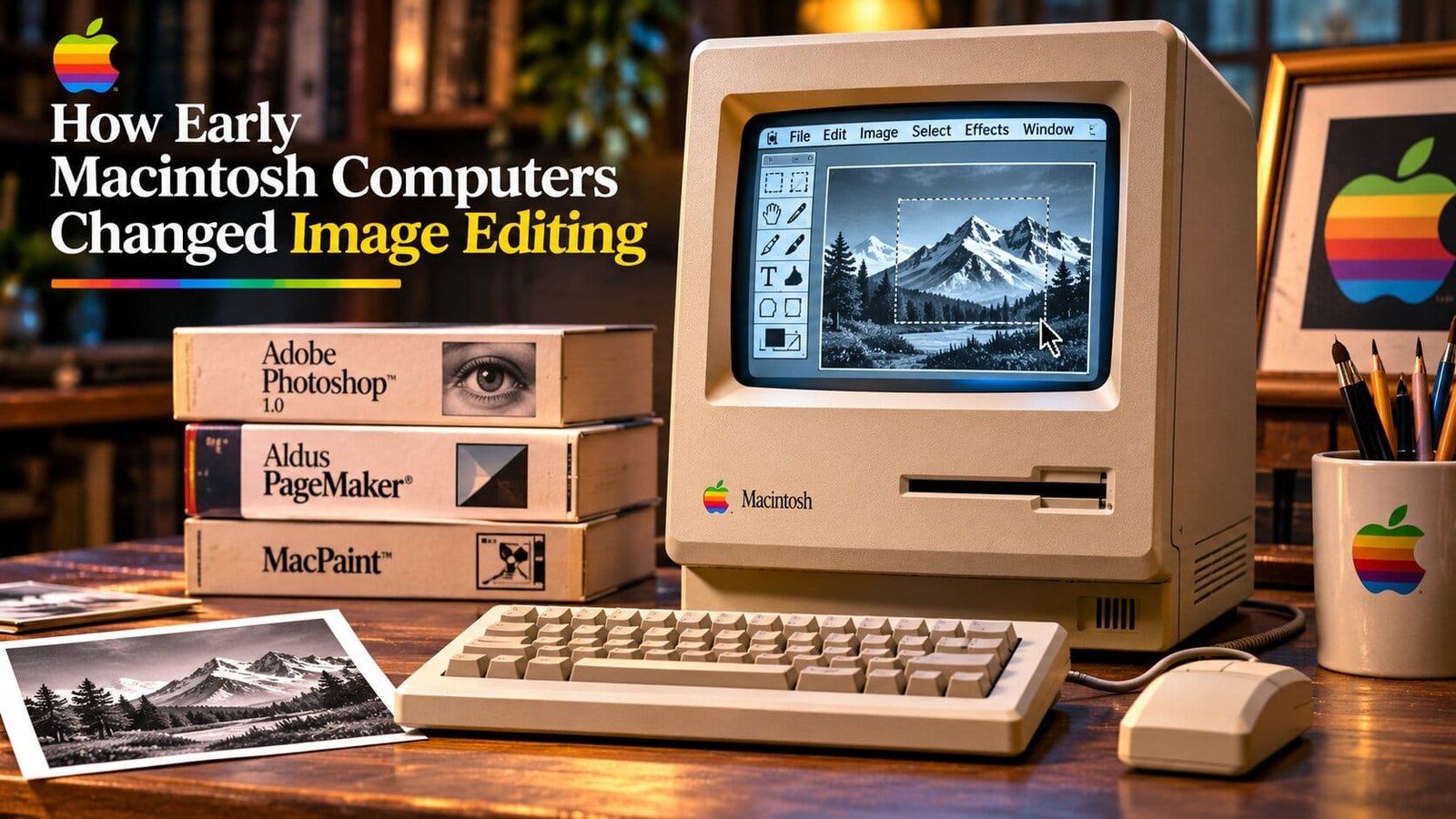
Released alongside the original Macintosh in 1984, MacPaint demonstrated the creative possibilities of personal computing.
The software allowed users to draw, erase, select, and manipulate black-and-white images with a mouse.
Its tools included brushes, shapes, patterns, and selection functions that became familiar elements of later graphics applications.
MacPaint was not a modern photographic editor, but it helped establish the interaction patterns that made digital artwork practical.
For many users, it was their first experience creating and editing images directly on a computer.
3. Macintosh II Brought Color Into the Picture
The introduction of the Macintosh II in 1987 represented an important milestone for computer graphics.
Unlike the original monochrome Macintosh, the Macintosh II supported color displays through its expandable graphics architecture.
With appropriate hardware, it could display sophisticated color images, making it more useful for photography, illustration, publishing, and digital imaging.
Color support expanded the possibilities for artists and photographers who needed to evaluate and modify images on-screen.
It also created opportunities to connect computers with emerging digital cameras, image capture systems, and color printers.
4. Digital Image Editing Became More Powerful
As Macintosh hardware improved, graphics applications became increasingly capable.
Programs such as Adobe Illustrator introduced sophisticated vector drawing workflows, while other software developers explored ways to capture, manipulate, and reproduce photographic images.
These tools helped creative professionals experiment with techniques that previously required expensive specialized equipment.
Digital editing offered several important advantages:
- Non-destructive experimentation: Artists could preserve original files while trying different creative approaches.
- Greater precision: Computer tools made it easier to manipulate shapes, lines, and image elements.
- Faster revisions: Changes could be made without recreating an entire physical composition.
- Digital storage: Artwork could be saved, duplicated, transferred, and reused.
- Integration with printing: Digital images could become part of electronic publishing and print production workflows.
Early systems still faced significant limitations in processing power, memory, storage, and image quality. Nevertheless, the direction of the industry was changing.
5. Kodak and Macintosh Helped Connect Digital Images With Printing
The growth of digital imaging was not limited to software.
Companies such as Eastman Kodak were exploring electronic photography, image capture, digital storage, and new printing technologies.
An important challenge was connecting these technologies into practical workflows.
A photographer or designer needed more than the ability to display an image. The complete process could involve capturing an image, transferring it to a computer, editing it, and producing a physical print.
Peter J. Sucy’s historical archive documents work on a Macintosh interface for Kodak’s SV6500 printer.
The SVPrinter software project was designed to support image capture, transfer to the Macintosh, editing, transfer back to the printer, and printing.
This illustrates how early Macintosh systems were becoming part of broader digital imaging solutions rather than functioning solely as standalone drawing computers.
6. The Macintosh Helped Shape Modern Creative Workflows
The influence of early Macintosh computers extended far beyond the 1980s.
Many concepts introduced or popularized during this period remain central to digital image editing:
- Visual editing with a mouse and graphical tools
- Image selection, copying, and manipulation
- Computer-based illustration and page layout
- Color graphics and on-screen previews
- Digital file storage and reuse
- Integration between image editing and printing
As computers became faster and software more advanced, these ideas developed into the sophisticated creative workflows used today.
Modern image editing applications can handle enormous image files, advanced color adjustments, layers, compositing, and AI-assisted tools.
Yet many of their fundamental interaction patterns can be traced to the early era of graphical personal computing.
7. Peter J. Sucy’s Journey Through Early Digital Imaging
Peter J. Sucy’s creative history offers a perspective on this technological transition.
His work and historical proposals connect photography, Macintosh software, Kodak electronic imaging systems, digital cameras, and image reproduction.
Projects documented in his archive include early Macintosh graphics software, image capture interfaces, digital imaging proposals, and color printing technologies.
Together, these chapters show how artists and technical innovators explored the possibilities of digital imagery long before today’s editing tools became commonplace.
Explore related chapters:
Conclusion: From Simple Pixels to Powerful Creative Tools
Early Macintosh computers helped change image editing by making visual computing accessible, supporting innovative graphics software, and eventually bringing color digital imaging into personal computer workflows.
From MacPaint’s simple drawing tools to Macintosh II color graphics and emerging Kodak imaging technologies, each development contributed to a larger transformation.
The result was a new creative environment where images could be captured, edited, stored, reproduced, and shared digitally.
The history of these innovations is also the story of how photography, art, and technology began to converge.
Discover more about the people, projects, and technologies behind this transformation in Peter J. Sucy’s Digital History Archive.