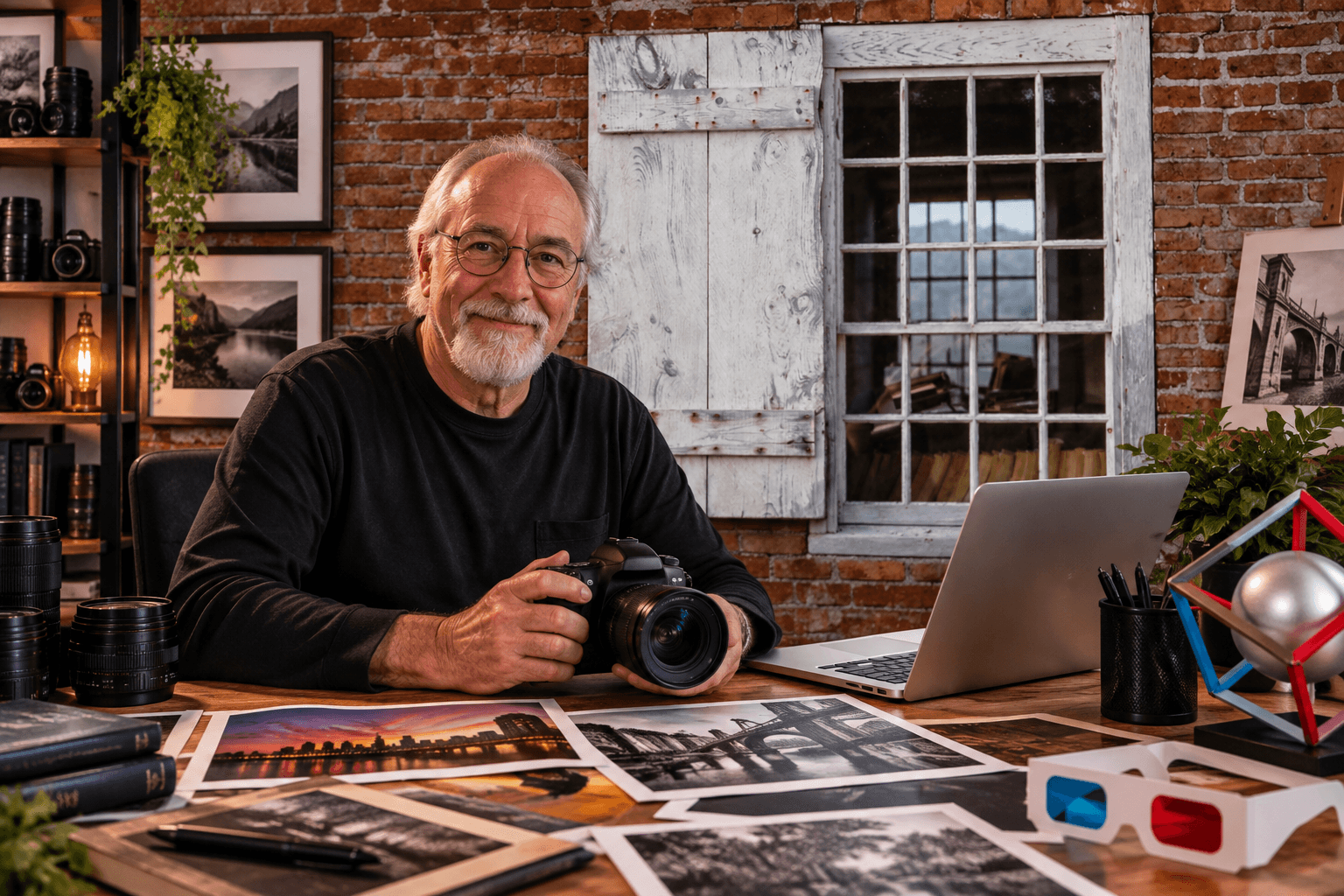
Photography has always been more than simply pressing a shutter. It is a way of preserving moments, exploring visual ideas, and seeing familiar places from a different perspective. As technology has changed, photography has changed with it—from film cameras and darkrooms to digital cameras, computer-based editing, 3D imaging, and completely new forms of digital artwork.
For artist and photographer Peter J. Sucy, this evolution represents more than a technological shift. It is a creative journey that connects traditional photography with modern digital expression.
The Beginning: Learning Through Film
Before digital photography became part of everyday life, photographers depended on film, physical negatives, careful exposure, and darkroom techniques. Every photograph required patience and planning.
Film encouraged photographers to think carefully before taking a picture. Lighting, composition, focus, and timing all mattered because each exposure was limited.
That traditional approach created a strong foundation for visual storytelling.
Entering the Digital Era
The arrival of digital imaging transformed the creative process. Images could now be captured, reviewed, edited, and reproduced with much greater flexibility.
Peter J. Sucy’s professional journey is closely connected with this transformation. His career has crossed animation, film, photography, digital photography, 3D illustration, design, and 3D imaging, reflecting the continuing relationship between technology and artistic creativity.
Digital tools didn’t replace photography—they expanded what photography could become.
A photograph could now be transformed through color, composition, perspective, layering, and digital manipulation. This opened the door to artwork that could exist somewhere between photography, illustration, design, and digital sculpture.
Beyond the Photograph
One of the most interesting aspects of digital art is the ability to move beyond a traditional two-dimensional image.
3D artwork and stereoscopic imagery can introduce depth and dimension, giving viewers a different way to experience an image. Instead of simply looking at a photograph, the viewer can feel as though they are looking into it.
Peter J. Sucy’s work in 3D anaglyphs is an example of this approach. His Virtual Visions series explores 3D artwork through anaglyph presentation, demonstrating how photographic and digital techniques can be combined to create a more immersive visual experience.
Technology as a Creative Tool
Technology is often associated with speed and efficiency, but for artists it can also become a creative instrument.
A camera captures the starting point. Editing software can reshape it. 3D tools can add depth. Printing can turn a digital creation into a physical object.
The final artwork is therefore not necessarily limited by the original photograph.
This is what makes digital creativity so interesting: the artist can continuously experiment.
Rochester, NY and Visual Inspiration
Rochester, New York has a particularly interesting connection with photography and imaging technology. The city has a long history associated with photography and innovation, making it a natural environment for exploring the relationship between traditional photographic practices and modern digital creativity.
Peter J. Sucy’s website presents this connection through photography, digital art, 3D artwork, products, and his broader “Silver to Silicon” retrospective.
The idea of moving from “silver” to “silicon” captures an important part of modern visual history: the transition from chemical-based photographic processes toward electronic and digital imaging.
Why Digital Art Still Matters
Digital art gives artists the freedom to experiment without being restricted to one medium.
A single idea can become:
- A photograph
- A digital composition
- A 3D artwork
- A printed piece
- A stereoscopic image
- A collectible digital design
This flexibility allows artists to continue developing their style as technology changes.
The tools may be different from those used decades ago, but the fundamental purpose remains the same—to communicate an idea, preserve a moment, create emotion, and encourage people to see something differently.
Looking Toward the Future
Photography will continue to evolve.
Artificial intelligence, 3D technologies, advanced cameras, virtual experiences, and increasingly powerful editing software are already changing how visual content is created.
But technology alone does not create meaningful art. The artist’s perspective remains essential.
The most interesting work often comes from combining experience with experimentation—using new technology while maintaining an understanding of composition, storytelling, photography, and visual culture.
Peter J. Sucy’s journey demonstrates how an artist can continue adapting while maintaining a connection to the history of imaging. From film and animation to digital photography and 3D creativity, the story is ultimately about one thing: continuing to explore what is possible with images.
Final Thoughts
The journey from film to digital is not simply a story about old technology becoming new technology. It is a story about how creative possibilities continue to expand.
Photography gave us a way to capture reality.
Digital art gave us new ways to reinterpret it.
3D imaging gave us another dimension.
And artists like Peter J. Sucy continue to explore the space where photography, technology, and creativity meet.
Explore the work of Peter J. Sucy and discover how decades of photographic experience can evolve into modern digital and 3D artistic expression.
Peter J. Sucy — Official Website