The Forgotten Innovations That Shaped Modern Multimedia
How early digital imaging, interactive software, computer graphics, and experimental technologies laid the foundation for today’s creative world.
Today, multimedia is everywhere. From streaming platforms and interactive websites to digital photography, animation, mobile applications, and immersive virtual experiences, modern technology allows us to combine images, video, audio, graphics, and text almost effortlessly.
But the foundations of this digital world were established decades before smartphones, social media, and high-speed internet became part of everyday life.
During the 1970s, 1980s, and 1990s, engineers, designers, programmers, and creative thinkers developed groundbreaking technologies that transformed how people interacted with computers and digital content.
Many of these innovations have faded from public memory, yet their influence remains deeply embedded in the tools we use today.
In this article, we explore the forgotten innovations that shaped modern multimedia and the pioneering ideas that helped transform computers from calculation machines into powerful creative platforms.
1. The Early Days of Computer Graphics
Before sophisticated graphic design software existed, creating digital images was a complicated process.
Early computers primarily relied on text-based interfaces, and visual computing required specialized hardware and technical expertise.
During the 1970s and 1980s, advances in graphics displays, memory, and software began changing this relationship.
Researchers and developers introduced systems capable of displaying shapes, illustrations, photographs, and increasingly complex visual information.
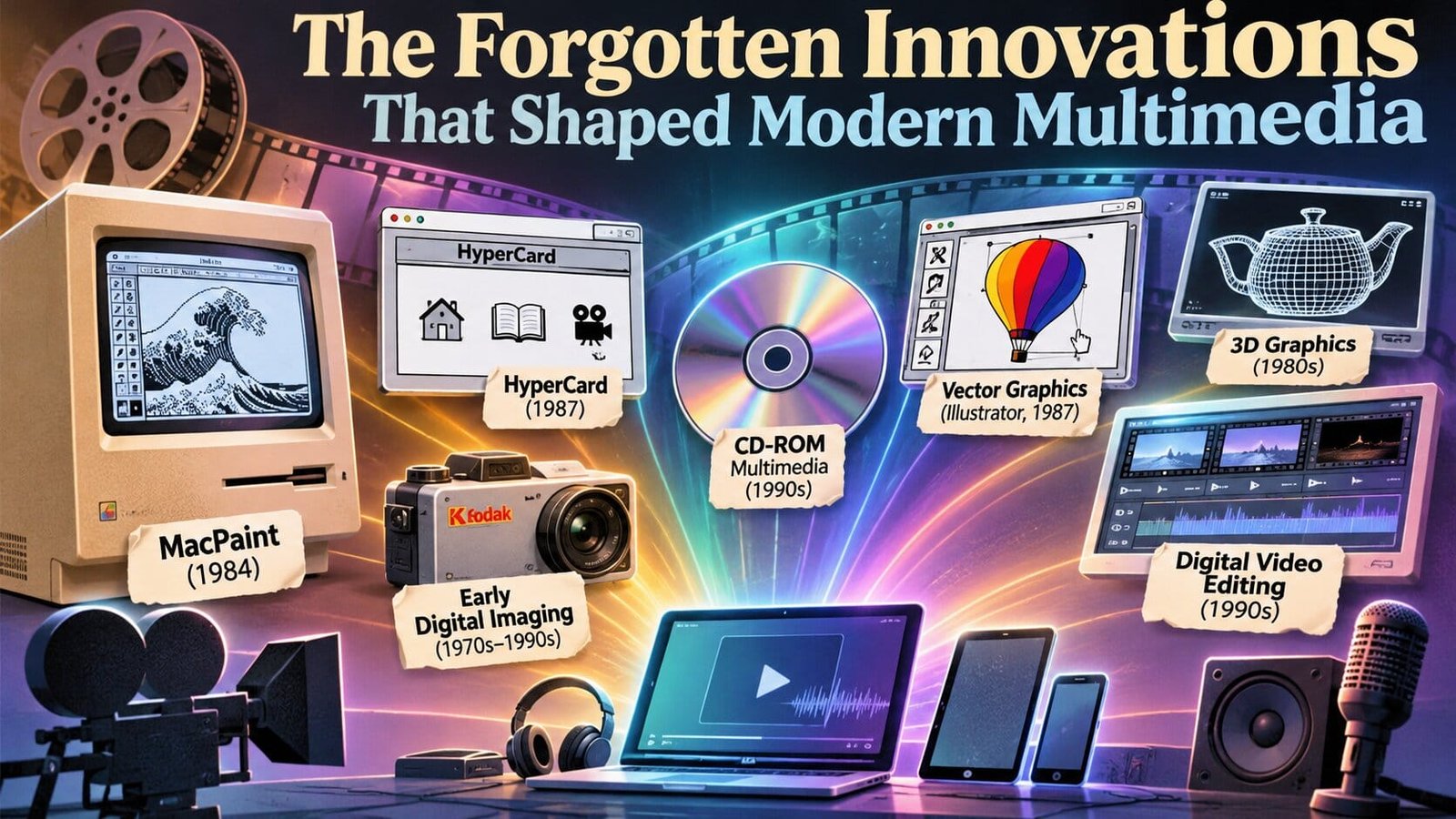
One important milestone was the introduction of the Apple Macintosh in 1984.
With its graphical user interface, mouse, and bundled MacPaint software, the Macintosh made digital drawing accessible to a much wider audience.
Why it mattered
MacPaint demonstrated that computers could be creative tools rather than simply machines for calculations and data processing.
Its influence can still be seen in modern applications such as Adobe Photoshop, digital illustration programs, and graphical user interfaces.
The idea that users could directly manipulate images on a screen became one of the defining principles of modern multimedia.
2. HyperCard: An Early Vision of Interactive Multimedia
Long before modern websites and mobile applications, Apple introduced a revolutionary software platform called HyperCard in 1987.
HyperCard allowed users to organize information into interconnected digital cards.
These cards could contain text, graphics, buttons, and interactive elements. Users could navigate between them, creating experiences that resembled modern websites and applications.
HyperCard also introduced HyperTalk, a scripting language that allowed users to add custom behavior without needing extensive programming experience.
Why HyperCard was revolutionary
HyperCard helped popularize several ideas that became central to modern computing:
-
Interactive navigation through linked information.
-
Visual application development.
-
User-created educational software.
-
Multimedia presentations and interactive storytelling.
-
Simple scripting for nonprofessional programmers.
Although HyperCard eventually disappeared from Apple’s mainstream software ecosystem, its underlying concepts influenced generations of interactive applications and multimedia authoring tools.
Its significance extends beyond software history. HyperCard represented a major shift toward empowering ordinary computer users to create their own digital experiences.
For a closer look at this technology, explore Apple’s HyperCard on Peter J. Sucy’s website.
3. The Digital Imaging Revolution
Photography was once entirely dependent on chemical processes, photographic film, and traditional darkroom techniques.
The development of digital imaging fundamentally changed that system.
Early experiments in electronic image capture demonstrated that photographs could be converted into digital information, processed by computers, and displayed electronically.
One of the most important early milestones came in 1975, when Kodak engineer Steven Sasson developed a prototype digital camera.
Although the device was primitive compared with modern cameras, it demonstrated the possibility of capturing photographs without conventional film.
Over the following decades, advances in image sensors, digital storage, image processing, and computer interfaces transformed photography.
The connection to modern multimedia
Digital imaging made it possible to:
-
Capture and manipulate photographs electronically.
-
Combine photography with computer-generated graphics.
-
Transfer visual information between devices.
-
Store and reproduce images without film.
-
Integrate photographs into digital publishing and interactive applications.
Companies such as Eastman Kodak, Apple, and numerous technology developers contributed to this transformation.
The digital imaging experiments of the 1980s and 1990s helped establish the technological foundation for modern smartphone cameras, digital photography, online image sharing, and visual communication.
4. The Macintosh II and the Rise of Color Graphics
When the original Macintosh arrived in 1984, its graphical interface was groundbreaking, but its built-in display was monochrome.
The introduction of the Macintosh II in 1987 represented another major step forward.
Unlike earlier compact Macintosh systems, the Macintosh II supported color graphics through expandable hardware and compatible displays.
This opened new possibilities for digital illustration, image processing, presentation design, and multimedia development.
Creative professionals could now work with increasingly sophisticated visual content on personal computers.
Why color computing mattered
Color graphics helped bridge the gap between traditional creative industries and emerging digital workflows.
Graphic designers, photographers, publishers, and multimedia developers gained access to new forms of visual experimentation.
The ability to combine color images, typography, and digital graphics helped establish the personal computer as a professional creative workstation.
Learn more about this period through Macintosh II Peripherals.
5. Adobe Illustrator and the Transformation of Digital Design
Before vector-based design tools became widespread, creating scalable digital illustrations required specialized systems and significant technical knowledge.
Adobe Illustrator, introduced in 1987, helped make vector graphics more accessible to professional designers.
Unlike pixel-based images, vector illustrations are constructed using mathematical paths and shapes.
This means they can be resized without losing their sharpness.
The introduction of powerful vector graphics software changed how designers approached logos, typography, technical illustrations, and commercial artwork.
Lasting impact
Vector graphics remain essential in modern design.
They are used in website interfaces, mobile applications, branding, animation, and scalable digital illustrations.
The ability to create precise, editable visual elements became a cornerstone of professional multimedia production.
Explore Adobe Illustrator for more historical context.
6. CD-ROM Technology and the Birth of Interactive Multimedia
During the late 1980s and 1990s, CD-ROM technology played a major role in bringing multimedia experiences to personal computers.
Before widespread broadband internet access, distributing large collections of images, audio, video, and interactive software was difficult.
CD-ROMs offered significantly more storage capacity than floppy disks, allowing developers to create richer digital experiences.
Interactive encyclopedias, educational programs, games, digital catalogs, and multimedia presentations became increasingly popular.
What made CD-ROM multimedia important?
CD-ROM technology allowed multiple forms of media to coexist within a single interactive application.
A user could read an article, view photographs, listen to audio recordings, watch video clips, and navigate between related subjects.
These experiences anticipated many of the interactive features now associated with websites, online learning platforms, and streaming applications.
Although CD-ROMs have largely disappeared from everyday use, the multimedia design principles they helped popularize remain relevant.
7. The Forgotten Experiments in Digital Video
Video production was once dominated by analog equipment, videotape, and specialized editing systems.
Editing video often involved physically moving between tape recordings and carefully assembling footage in sequence.
The emergence of digital video technologies began transforming this process.
Early digital video systems explored ways to capture, store, manipulate, and reproduce moving images using computers.
These experiments faced major technical challenges, including limited processing power, expensive storage, and restricted data transfer speeds.
Despite these obstacles, researchers and developers continued pushing the boundaries of what personal computers could accomplish.
The foundation of modern video editing
Digital video innovations eventually contributed to nonlinear editing systems.
Instead of editing footage sequentially on tape, editors could access and rearrange digital clips within computer software.
This approach became fundamental to applications such as Adobe Premiere Pro, Final Cut Pro, and DaVinci Resolve.
Modern video production, online content creation, and digital filmmaking owe much to these early experiments.
Related historical material can be explored in Digital Audio Video Device.
8. Early 3D Graphics and Digital Visualization
Today, three-dimensional graphics are central to movies, architecture, product design, gaming, and virtual reality.
However, early 3D graphics systems were limited by the processing power and memory available at the time.
Creating even relatively simple three-dimensional objects could require specialized software and expensive computer hardware.
During the 1980s and 1990s, advances in graphics algorithms, rendering techniques, and computer hardware helped make 3D visualization more practical.
Researchers and artists experimented with wireframe models, shaded surfaces, lighting effects, and computer-generated animation.
From experimentation to everyday technology
These developments helped establish the foundations for modern 3D modeling, animation, virtual environments, and digital special effects.
What once required specialized research facilities can now be accomplished using widely available creative software.
The evolution of 3D graphics demonstrates how experimental technologies can eventually become essential tools across multiple industries.
Read more in 3D Applications.
9. Optical Storage and the Search for Better Digital Media
The development of multimedia created an urgent need for more efficient ways to store and retrieve digital information.
Photographs, audio recordings, animations, and video files required far more storage capacity than traditional text documents.
During the 1980s, researchers and technology companies explored optical disks and other storage technologies as potential solutions.
These systems offered opportunities to store substantial amounts of digital information and retrieve it electronically.
Some experimental systems were designed specifically for image libraries, multimedia presentations, and professional visual applications.
Although not every concept became commercially successful, these experiments helped shape later developments in digital storage and media distribution.
The history of optical storage illustrates an important principle of technological innovation: even ideas that never achieve widespread adoption can influence future breakthroughs.
10. The People Behind the Technology
Technological history is often told through famous products and major corporations.
Yet many important breakthroughs emerged from smaller teams, experimental projects, and individuals working behind the scenes.
Engineers developed new hardware interfaces. Programmers created innovative software tools. Designers explored unfamiliar creative possibilities. Researchers challenged the limitations of existing technology.
Their work frequently involved trial and error, technical constraints, and ideas that were ahead of their time.
Some projects became successful commercial products.
Others remained prototypes, internal proposals, or experimental systems.
Nevertheless, each contributed to a broader process of technological discovery.
Preserving the history of innovation
Documenting these early projects is important because technological progress rarely happens through a single invention.
Instead, it emerges from countless experiments, collaborations, and incremental improvements.
Personal archives, technical documents, photographs, and firsthand accounts provide valuable insights into how the digital world developed.
Peter J. Sucy’s website preserves examples of this history through material relating to early Macintosh technology, digital imaging, multimedia experiments, and creative computing.
These records help connect today’s digital tools with the people and ideas that made them possible.
11. How Forgotten Innovations Continue to Shape Our Digital World
The influence of early multimedia technologies can be seen throughout modern computing.
| Early innovation | Modern influence |
|---|---|
| MacPaint and graphical interfaces | Digital illustration and image editing |
| Apple HyperCard | Interactive applications and linked content |
| Early digital cameras | Smartphone photography and digital imaging |
| Macintosh II color graphics | Professional visual design and multimedia |
| Vector graphics software | Logos, scalable illustrations, and interface design |
| CD-ROM multimedia | Interactive learning and rich digital content |
| Digital video experiments | Nonlinear editing and online video production |
| Early 3D graphics | Animation, gaming, CGI, and virtual reality |
| Optical storage research | Digital media storage and distribution |
What makes these innovations remarkable is not simply their technical achievements, but the way they changed expectations about computers.
Computers gradually evolved from machines used primarily for calculations and business tasks into platforms for creativity, communication, storytelling, and artistic expression.
Each generation of technology built upon the experiments of the previous one.
12. Why Understanding Multimedia History Matters Today
Modern technology develops rapidly, and new tools frequently replace older systems.
Artificial intelligence, immersive media, augmented reality, and cloud-based creative platforms continue to reshape how digital content is produced and experienced.
Yet many of the underlying concepts are not entirely new.
Interactive interfaces, computer-generated imagery, digital storytelling, and automated creative workflows have roots stretching back several decades.
Understanding this history provides a clearer perspective on modern innovation.
It reminds us that groundbreaking technologies often begin as experimental ideas that seem impractical or unnecessary at the time.
It also highlights the importance of preserving historical records before they disappear.
The early pioneers of multimedia were not simply developing new products. They were exploring entirely new ways for people to communicate, create, and interact with information.
Conclusion: Remembering the Innovations That Made Multimedia Possible
The multimedia experiences we enjoy today are the result of decades of experimentation, creativity, and technological progress.
From the first accessible graphical drawing programs to interactive software, digital cameras, color computing, video editing, and 3D visualization, early innovations transformed the possibilities of personal computing.
Many of these technologies are no longer used in their original forms.
However, their ideas continue to influence the digital tools that shape modern life.
By exploring and preserving the history of these forgotten innovations, we gain a deeper appreciation for the creativity, determination, and technical imagination that made today’s multimedia world possible.
The future of digital creativity is built upon the innovations of the past.
To discover more about early digital imaging, Macintosh technology, multimedia development, and the history of creative computing, visit Peter J. Sucy’s website.