The Rise of Multimedia Technology in the 1980s and 1990s
How personal computers, digital imaging, animation, and interactive media transformed the creative world.
The 1980s and 1990s marked a revolutionary period in the history of technology. During these two decades, computers evolved from machines primarily used for calculations, business applications, and basic text processing into powerful creative tools capable of combining graphics, sound, animation, video, and interactive experiences.
This transformation gave rise to multimedia technology, fundamentally changing how people created, communicated, learned, and experienced digital content.
From the introduction of the Apple Macintosh to the development of digital imaging systems, CD-ROM applications, and interactive software, multimedia innovation laid the foundation for today’s digital world.
What Is Multimedia Technology?
Multimedia technology refers to the integration of multiple forms of digital content into a single computer-based experience.
These elements include:
- Text: Digital documents, typography, and interactive information.
- Graphics: Computer-generated illustrations, photographs, and visual designs.
- Audio: Digitally recorded music, speech, and sound effects.
- Video: Moving images captured, edited, and displayed electronically.
- Animation: Computer-generated motion and visual effects.
- Interactivity: User-controlled navigation and responses within digital applications.
Before the 1980s, many of these technologies existed independently. The development of more capable personal computers made it increasingly practical to combine them into integrated multimedia experiences.
1. The 1980s: The Beginning of the Multimedia Revolution
The 1980s introduced several technological innovations that would reshape the creative industry.
Personal computers became more accessible, graphical interfaces improved, and digital imaging began moving beyond specialized research laboratories.
The Apple Macintosh Changed Everything
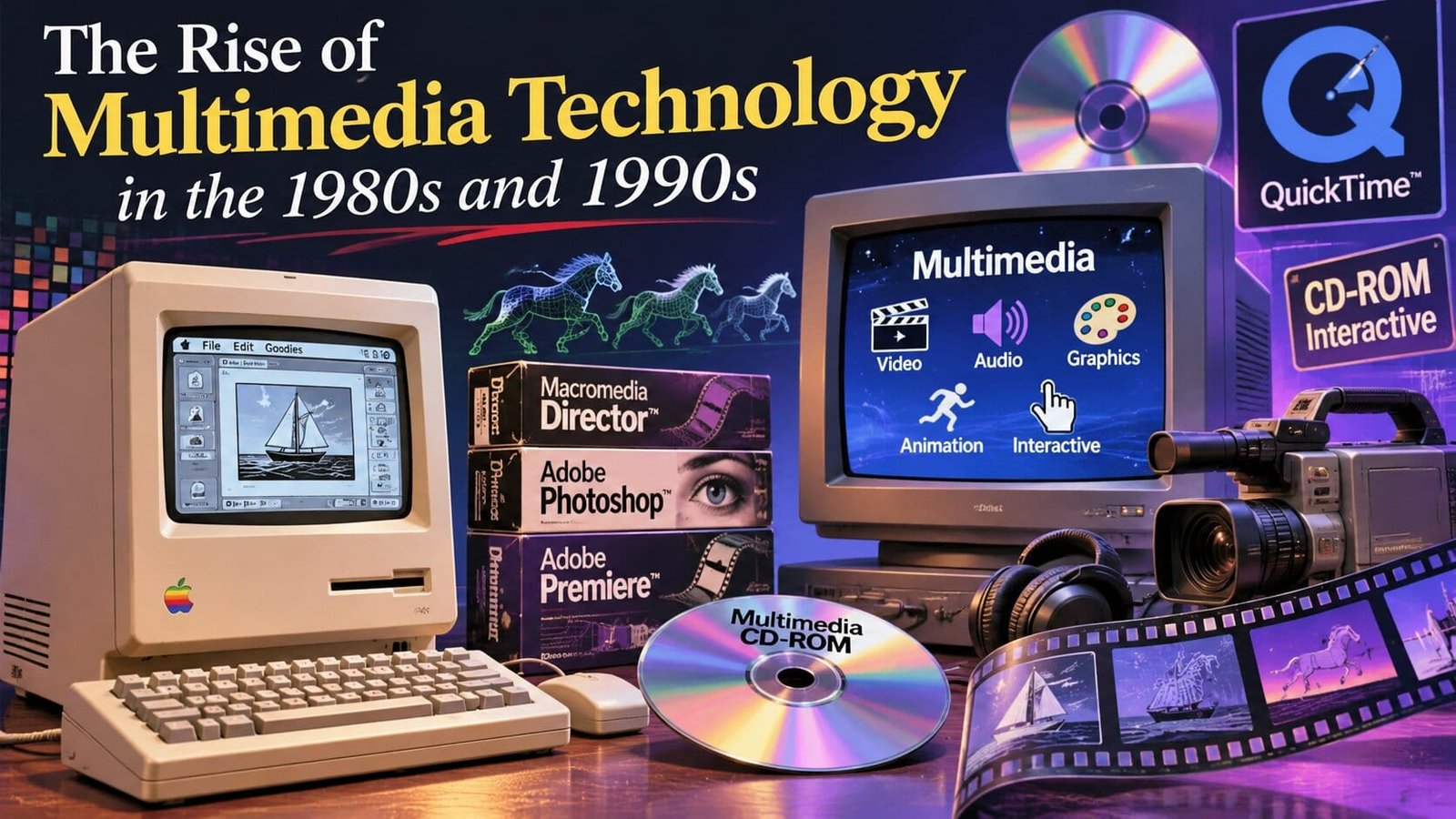
In 1984, Apple introduced the original Macintosh, featuring a graphical user interface, mouse-based navigation, and a compact all-in-one design.
Unlike many earlier personal computers that relied heavily on typed commands, the Macintosh allowed users to interact with visual elements directly.
Applications such as MacPaint and MacWrite demonstrated how computers could become practical tools for artists, designers, writers, and creative professionals.
The Macintosh helped make digital creativity accessible to a much broader audience.
Its graphical approach encouraged developers to explore new possibilities in illustration, typography, image manipulation, and eventually multimedia production.
Early Computer Graphics and Digital Art
During the 1980s, computer graphics underwent rapid development.
Artists and engineers experimented with:
- Bitmap graphics and pixel-based illustrations.
- Computer-assisted animation.
- Digital typography and page layout.
- Image scanning and manipulation.
- Early three-dimensional modeling.
- Electronic image storage and reproduction.
These developments helped establish the foundation for modern graphic design, digital photography, and visual effects.
2. The Evolution of Digital Imaging and Photography
One of the most important developments of this era was the transition from traditional photographic processes toward digital imaging.
Companies such as Eastman Kodak explored technologies for capturing, storing, processing, and reproducing images electronically.
Early digital imaging systems were often expensive and specialized, but they demonstrated the potential to transform photography and publishing.
From Film to Digital Images
Traditional photography relied on chemical film processing. Digital imaging introduced an alternative approach in which visual information could be represented as electronic data.
This made it possible to manipulate images using computer software, transfer pictures electronically, and incorporate photographs into digital documents.
Important developments included:
- Electronic image sensors and digital capture systems.
- Film scanners and image digitization.
- Computer-based image enhancement.
- Digital color correction.
- High-resolution image storage.
- Integration between cameras, computers, and printers.
These technologies eventually contributed to the widespread adoption of digital cameras and computer-based photography workflows.
Peter J. Sucy’s Connection to Early Digital Imaging
The history of multimedia technology is closely connected to the work of creative professionals who explored the intersection of photography, computers, and electronic imaging.
Peter J. Sucy’s documented career and technology proposals provide a valuable perspective on this period of experimentation.
His historical archive covers subjects including the Macintosh, Eastman Kodak, digital camera proposals, image acquisition, and emerging computer graphics technologies.
These projects illustrate how creative ideas and technical experimentation contributed to the development of digital imaging.
Explore more: Peter J. Sucy’s Technology History
3. The Rise of Desktop Publishing and Digital Design
Another major milestone of the 1980s was the emergence of desktop publishing.
Previously, professional page layout and typesetting required specialized equipment and production processes.
Personal computers began bringing these capabilities directly to designers and publishers.
Key Technologies That Transformed Publishing
Apple Macintosh: Provided an accessible graphical environment for creating and editing documents.
Apple LaserWriter: Introduced in 1985, it helped bring high-quality laser printing into computer-based publishing workflows.
Adobe PostScript: Enabled sophisticated descriptions of text and graphics for professional-quality printing.
Aldus PageMaker: Helped popularize desktop page layout.
Adobe Illustrator: Introduced in 1987, it expanded the possibilities of vector-based digital illustration.
Together, these technologies transformed the production of magazines, brochures, advertisements, books, and other printed materials.
Desktop publishing also demonstrated a broader principle of multimedia innovation: computers could bring previously separate creative processes together within one digital workspace.
4. The Late 1980s: HyperCard and Interactive Computing
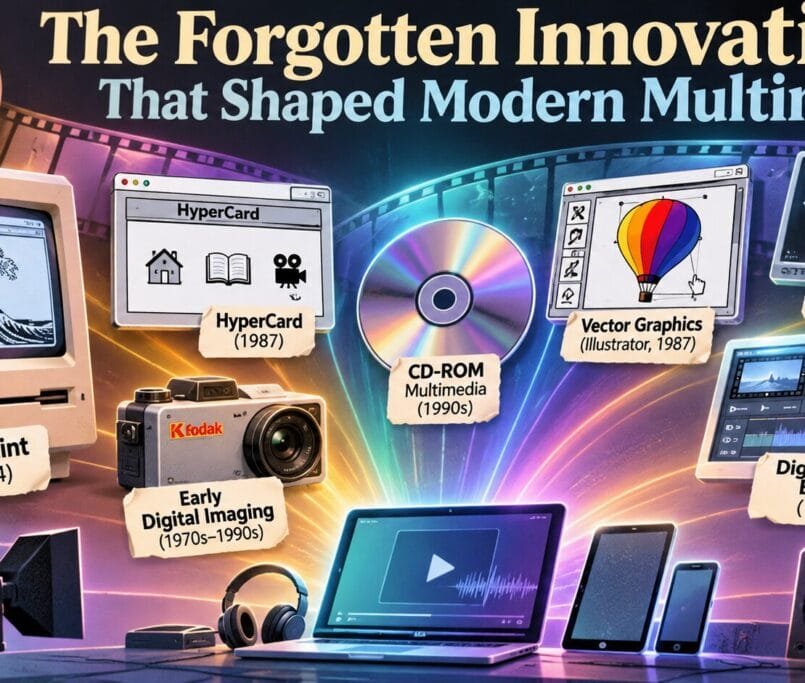
In 1987, Apple introduced HyperCard, a groundbreaking software environment that allowed Macintosh users to create interactive applications.
HyperCard organized information into stacks of virtual cards containing text, images, buttons, and scripts.
Users could navigate between cards and build interactive experiences without needing extensive traditional programming knowledge.
Why HyperCard Was Important
HyperCard helped popularize several ideas that later became central to multimedia and interactive software:
- Nonlinear navigation between information screens.
- Interactive educational applications.
- Digital reference materials.
- User-created software tools.
- Hyperlinked information systems.
- Scriptable graphical interfaces.
Although HyperCard was not a complete modern multimedia platform at its introduction, it helped establish important concepts for interactive content creation.
Its influence can be seen in the broader development of educational software, interactive presentations, and hypermedia applications.
For more historical context, explore Apple’s HyperCard.
5. The 1990s: Multimedia Becomes Mainstream
The 1990s represented a turning point when multimedia capabilities became increasingly common in personal computers.
Faster processors, improved graphics hardware, larger storage devices, and better sound capabilities allowed developers to combine multiple types of digital media.
The CD-ROM Revolution
One of the defining multimedia technologies of the 1990s was the CD-ROM.
Compared with floppy disks, CD-ROMs offered substantially greater storage capacity, making it practical to distribute applications containing extensive graphics, recorded audio, animation, and video.
CD-ROM technology supported a new generation of digital products, including:
- Interactive encyclopedias.
- Educational learning programs.
- Multimedia games.
- Digital art collections.
- Interactive museum presentations.
- Computer-based training applications.
Products such as Microsoft Encarta demonstrated how multimedia could transform traditional reference materials into interactive learning experiences.
Rather than simply reading static information, users could explore images, hear audio recordings, watch animations, and navigate related topics.
6. QuickTime and the Growth of Digital Video
In 1991, Apple introduced QuickTime, an important multimedia framework that brought digital video playback and related media capabilities to Macintosh computers.
QuickTime helped developers incorporate moving images and sound into software applications.
Before technologies such as QuickTime became widely available, digital video on personal computers faced major limitations involving processing power, storage, and playback performance.
As hardware and compression techniques improved, digital video became increasingly practical.
How Digital Video Changed Creative Work
The development of computer-based video technology contributed to several important changes:
Video editing: Creative professionals increasingly gained access to software-based editing workflows.
Interactive presentations: Businesses and educators could combine video clips with graphics and text.
Animation: Digital tools supported new methods of producing and presenting moving images.
Multimedia publishing: Developers could distribute richer content through CD-ROM applications and other digital formats.
These advances helped establish the foundations of modern video editing, online streaming, and digital content production.
7. Adobe Photoshop, Premiere, and Digital Creativity
The early 1990s also witnessed the expansion of professional creative software.
Adobe Photoshop, released in 1990, became an influential tool for digital image editing and manipulation.
Adobe Premiere, introduced in 1991, brought timeline-based video editing capabilities to personal computers.
These applications helped establish workflows that remain familiar today.
A New Creative Workflow
Digital creators could increasingly:
- Capture or scan photographs.
- Edit and enhance images on a computer.
- Create illustrations and graphical elements.
- Combine graphics with digital video.
- Add sound and animation.
- Export or distribute finished multimedia content.
This integration reduced dependence on separate analog production processes and opened new creative possibilities.
The ability to work across different media types became a defining characteristic of the multimedia era.
8. The Emergence of 3D Graphics and Computer Animation
Throughout the 1980s and 1990s, three-dimensional computer graphics progressed from specialized technical applications toward mainstream entertainment and design.
Improved computer performance enabled increasingly sophisticated modeling, rendering, and animation.
Important Applications of 3D Technology
- Film and television visual effects.
- Architectural visualization.
- Industrial and product design.
- Scientific simulations.
- Computer games.
- Animated films.
- Interactive virtual environments.
The release of Toy Story in 1995, the first feature-length computer-animated film, demonstrated the creative potential of fully digital 3D animation.
Computer graphics were no longer limited to technical demonstrations or short experimental sequences. They were becoming central to commercial entertainment and visual storytelling.
9. The Internet Expands Multimedia Possibilities
During the 1990s, the growth of the World Wide Web created an entirely new environment for multimedia distribution.
Early websites primarily contained text and static images, but web technologies gradually introduced more interactive and media-rich experiences.
Developments in web browsers, image formats, audio playback, and browser plugins made it possible to deliver increasingly sophisticated digital content.
By the late 1990s, websites were beginning to incorporate:
- Animated graphics.
- Embedded audio.
- Digital video.
- Interactive navigation.
- Online educational content.
- Multimedia presentations.
Internet connection speeds remained a significant limitation, particularly for video, but the direction of technological development was clear.
Multimedia was moving beyond standalone computers and physical storage media toward networked digital experiences.
10. How Multimedia Technology Changed the Creative Industry
The rise of multimedia technology transformed far more than computer software.
It fundamentally changed the relationship between creativity and technology.
Graphic Design
Digital illustration and image-editing applications enabled designers to experiment with new visual techniques and production workflows.
Photography
Electronic imaging and computer-based editing helped establish the foundations of modern digital photography.
Film and Video
Nonlinear editing systems, digital effects, and computer animation introduced new methods of visual storytelling.
Education
Interactive learning applications combined text, images, narration, and animation to make complex subjects more engaging.
Business Communication
Multimedia presentations changed how companies communicated ideas, demonstrated products, and trained employees.
Entertainment
Video games, computer animation, and interactive storytelling created new forms of digital entertainment.
These developments helped establish the creative and technological industries that continue to shape our lives today.
11. The Lasting Legacy of the Multimedia Revolution
Many technologies we use today can be traced back to innovations developed or popularized during the 1980s and 1990s.
Modern smartphones, video editing applications, digital cameras, interactive websites, and online learning platforms all build upon concepts explored during this transformative period.
The most important legacy of the multimedia revolution was not a single computer, software application, or storage format.
It was the realization that digital technology could bring together visual art, photography, sound, video, animation, and human interaction within one creative environment.
This idea continues to drive innovation in digital media, virtual reality, interactive design, and modern content creation.
Conclusion: Two Decades That Redefined Digital Creativity
The rise of multimedia technology in the 1980s and 1990s represented one of the most significant transformations in the history of personal computing.
From the original Apple Macintosh and early digital imaging systems to HyperCard, QuickTime, CD-ROM publishing, and computer animation, these decades established the foundations of modern multimedia.
What began as experimental technology evolved into essential tools for artists, designers, photographers, educators, filmmakers, and businesses.
The historical work documented by Peter J. Sucy offers a perspective on this evolution, highlighting the relationship between creative experimentation and technological progress.
Understanding this history helps us appreciate how today’s digital experiences emerged from decades of innovation, exploration, and creative problem-solving.
Explore more about the evolution of computer graphics, digital photography, and multimedia innovation at Peter J. Sucy.
Frequently Asked Questions
What is multimedia technology?
Multimedia technology combines text, graphics, audio, video, animation, and interactive elements into integrated digital experiences.
When did multimedia technology become popular?
Multimedia technology developed significantly during the 1980s and became increasingly popular during the 1990s as personal computers gained better graphics, sound, processing power, and CD-ROM storage.
How did the Macintosh contribute to multimedia development?
The Apple Macintosh helped popularize graphical user interfaces and creative software, making digital design, image editing, and interactive applications more accessible.
Why were CD-ROMs important in the 1990s?
CD-ROMs provided enough storage to distribute applications containing substantial amounts of graphics, audio, video, and interactive educational content.
What was the impact of QuickTime?
QuickTime helped bring digital video and synchronized media playback into personal computer applications, supporting the growth of multimedia publishing and digital video production.