Apple’s Hypercard
Peter J. Sucy · Creative Journey
Apple’s HyperCard
Exploring Apple’s 1987 graphical database and the creative possibilities of programming with stacks and cards on the Macintosh.
The Beginning
Apple Introduces HyperCard
Apple had announced HyperCard in 1987. A powerful graphical database, with an object oriented programming language, HyperCard was a very easy programming language for novices, as it was mostly like spoken English.
There were great possibilities with this software, from databases to instructional programming. You wrote a program that was called a “Stack”, basically a stack of cards that could be randomly accessed with hyperlinks (like today’s internet). You could place graphics or photos on the cards, create buttons with code to direct you somewhere, or perform some action.
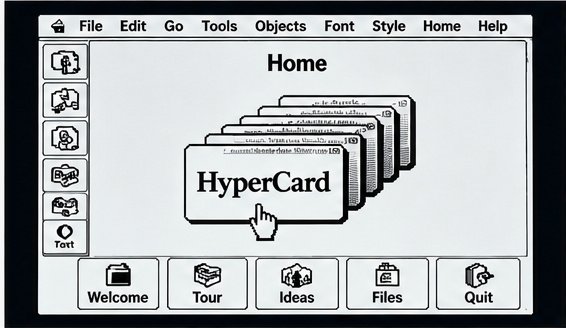
Historical-style illustrations; not original archival photographs

Creating with HyperCard
A Flexible Creative Tool
HyperCard was a lot of fun to play with. I used it for a number of personal projects, like a random art generator, some small databases and I wrote a stack to control my Yamaha synthesizer.
I could control nearly every slider and button on the synth from my HyperCard stack and even have it randomly generate new instrument voices for me.
HyperCard was limited to B&W graphics, however, a company named Silicon Beach Software came out with SuperCard shortly after. SuperCard offered 8-bit color and some more advanced programming features.
I found it a very useful tool for me to design software applications. I could mock up the look and the user interface as a point of reference in discussions and quickly make changes afterwards to reflect those changes. I’d prototype a number of imaging applications using SuperCard.
Continue the Journey
Explore More of My Work
Discover more of Peter J. Sucy’s creative journey through photography, Macintosh software, digital imaging and art.
Explore My Creative History →