Photography has always been more than simply pointing a camera at a subject and pressing a button. It is a way of observing the world, preserving moments, experimenting with ideas, and communicating something that words cannot always express. As technology has changed, the creative possibilities available to photographers and digital artists have expanded dramatically.
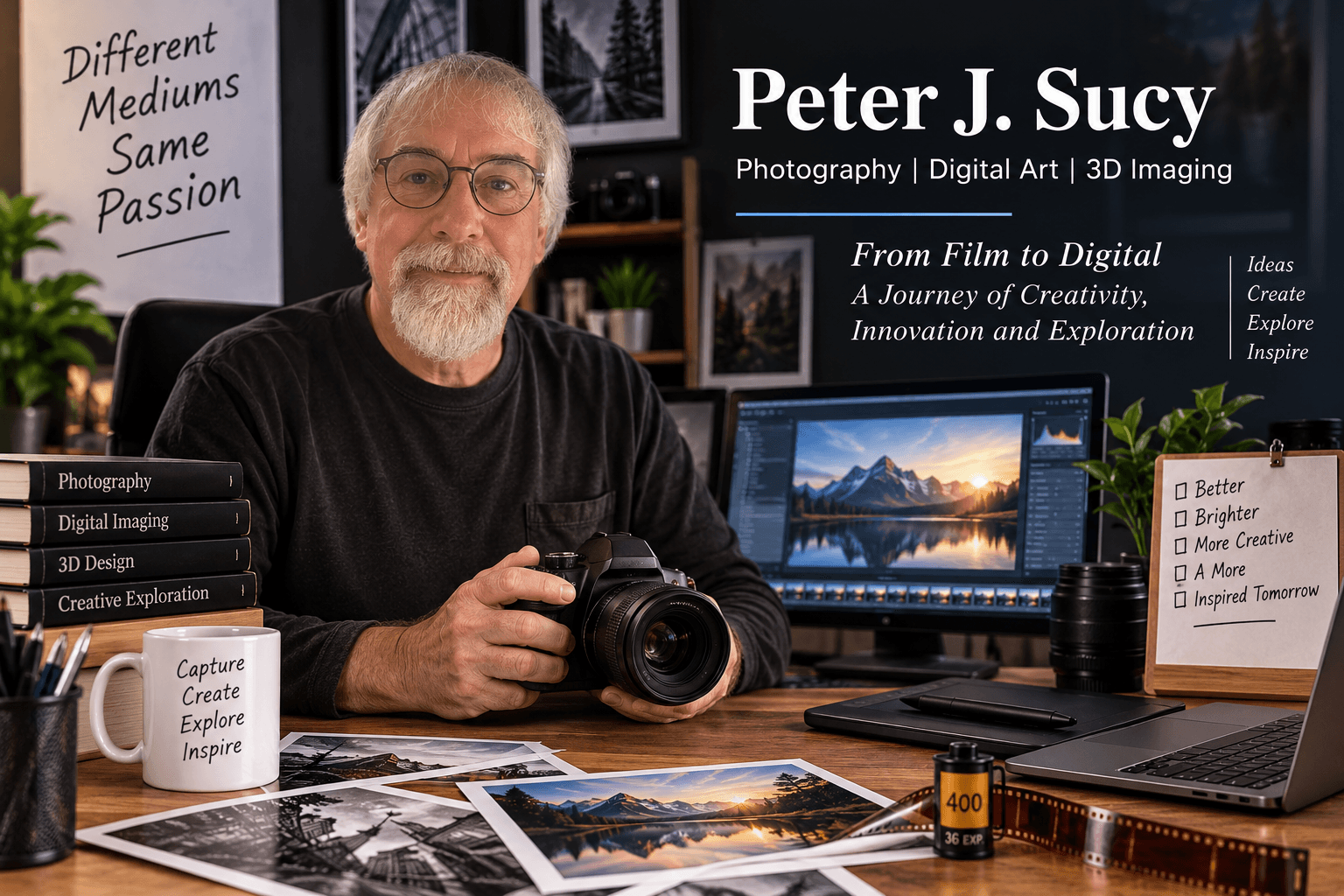
The transition from traditional film photography to digital imaging is one of the most important changes in modern visual media. Peter J. Sucy has experienced this evolution firsthand, developing a creative career that connects photography, animation, digital imaging, 3D artwork, illustration, and other forms of visual expression.
A Creative Journey Across Changing Technology
Peter J. Sucy’s work reflects a period in which visual technology changed rapidly. Traditional film photography once required careful planning, physical film, processing, and specialized equipment. Digital technology introduced a completely different workflow, allowing images to be reviewed, edited, stored, and shared with much greater flexibility.
For an artist, however, learning new technology is only part of the journey. The more important challenge is understanding how those tools can be used creatively.
Peter’s experience demonstrates this balance between technical development and artistic curiosity. Rather than being limited to one particular medium, his work has explored different approaches to creating and presenting visual ideas.
From Film Photography to the Digital Age
The move from film to digital photography changed the way photographers worked.
With film, every exposure had to be considered carefully because photographers could not immediately see the finished photograph. Digital cameras changed that process by providing instant feedback and making experimentation much easier.
But the transition was not simply about replacing one type of camera with another. Digital imaging introduced new possibilities for editing, manipulation, composition, storage, printing, and distribution.
Peter J. Sucy’s professional experience with this transition gives his creative journey particular significance. His background includes involvement with Kodak and the development of digital photography, connecting his work with an important chapter in the evolution of imaging technology.
Photography as a Starting Point for Creativity
A photograph can be the final product, but it can also be the beginning of something else.
Digital tools allow a photographer to adjust an image, combine different visual elements, create illustrations, develop unusual compositions, or transform a conventional photograph into something completely different.
This broader approach to imagery can be seen throughout Peter’s creative interests. His work extends beyond conventional photography into digital art and 3D imaging, demonstrating how a single visual idea can evolve into different forms.
The result is an approach where photography and technology support each other rather than existing separately.
Exploring 3D Art and Digital Imaging
Three-dimensional artwork provides another way to think about visual storytelling.
Instead of presenting an image only as a flat surface, 3D techniques can introduce depth, perspective, structure, and a different relationship between the viewer and the subject.
Peter’s work with 3D illustration and imaging shows an interest in exploring these additional possibilities. It also demonstrates how digital tools can expand the creative vocabulary available to an artist.
For viewers, this type of work can make familiar subjects feel new. For the creator, it creates opportunities to experiment with perspective, form, lighting, and visual presentation.
The Value of Experimentation
Creative careers rarely follow a perfectly straight path.
Artists often discover new interests by experimenting with different techniques and technologies. Something that begins as a technical experiment can eventually become an important part of a creative practice.
Peter J. Sucy’s journey illustrates this willingness to explore. Moving between film, photography, digital imaging, animation, illustration, and 3D work requires curiosity and a willingness to learn.
That attitude is particularly relevant today, when creative technology continues to evolve at a remarkable pace.
Learning From the Evolution of Photography
Looking at Peter’s career also provides an opportunity to understand how photography itself has changed.
Earlier generations of photographers worked with physical film and traditional processing techniques. Today’s photographers can work with powerful digital cameras, editing applications, high-resolution displays, cloud storage, and sophisticated imaging software.
Yet many of the fundamental principles remain the same.
Composition, light, perspective, timing, storytelling, and an understanding of the subject are still central to good visual work.
Technology can make the process faster and provide more possibilities, but creative judgment remains essential.
Why the Film-to-Digital Story Matters
The story of the transition from film to digital is important because it represents much more than a technological upgrade.
It shows how creative professionals adapt when familiar methods begin to change. It also demonstrates that learning new tools does not mean abandoning everything that came before.
Experience with traditional photography can provide a strong foundation for working with digital technology. Knowledge of composition and visual storytelling remains useful regardless of whether the final image is captured on film, created digitally, or produced through a combination of techniques.
Peter J. Sucy’s career provides an interesting example of this continuity.
Combining Technical Knowledge With Artistic Vision
One of the strengths of working across different creative disciplines is the ability to look at a project from multiple perspectives.
A photographer may think about light and composition. A designer may think about layout and visual balance. A 3D artist may think about depth and structure. A digital artist may think about how individual elements can be transformed or combined.
When these perspectives come together, the possibilities become much broader.
Peter’s work across photography, digital art, and 3D imaging reflects this type of multidisciplinary creative thinking.
Creativity in a Digital World
Today, almost anyone can take a photograph within seconds. Smartphones have made cameras accessible to billions of people, while digital platforms make it easy to publish images to audiences around the world.
This accessibility has created more opportunities for photographers and artists, but it has also made originality more important.
Simply having access to technology is not enough. What matters is how a person uses that technology to communicate an idea.
Peter J. Sucy’s journey is a useful reminder that creativity comes from curiosity, observation, experimentation, and experience—not simply from owning the latest equipment.
Looking Back While Moving Forward
There is something valuable about looking back at the technologies that shaped modern digital creativity.
The tools available today are built on decades of experimentation and development. The transition from film photography to digital imaging helped establish many of the workflows that are now taken for granted.
Artists who experienced those changes firsthand can offer a unique perspective on how quickly creative technology can evolve.
Peter J. Sucy’s story provides that perspective while also showing how a creative career can continue to develop as new technologies become available.
Final Thoughts
Peter J. Sucy’s creative journey is a story of photography, technology, experimentation, and adaptation.
From the world of film to digital photography and from traditional visual approaches to 3D imaging and digital artwork, his work reflects the continuing relationship between creativity and technology.
The tools may continue to change. Cameras will become more advanced, software will introduce new capabilities, and entirely new forms of visual media will emerge. But the fundamental purpose of creative work remains the same: to see something differently and give that idea a form that others can experience.
For anyone interested in photography, digital art, imaging technology, or the history of visual creativity, Peter J. Sucy’s journey offers an engaging example of how curiosity and creativity can continue to evolve across generations of technology.
Explore Peter J. Sucy’s work and creative journey:
https://www.peterjsucy.com/